One ticket short
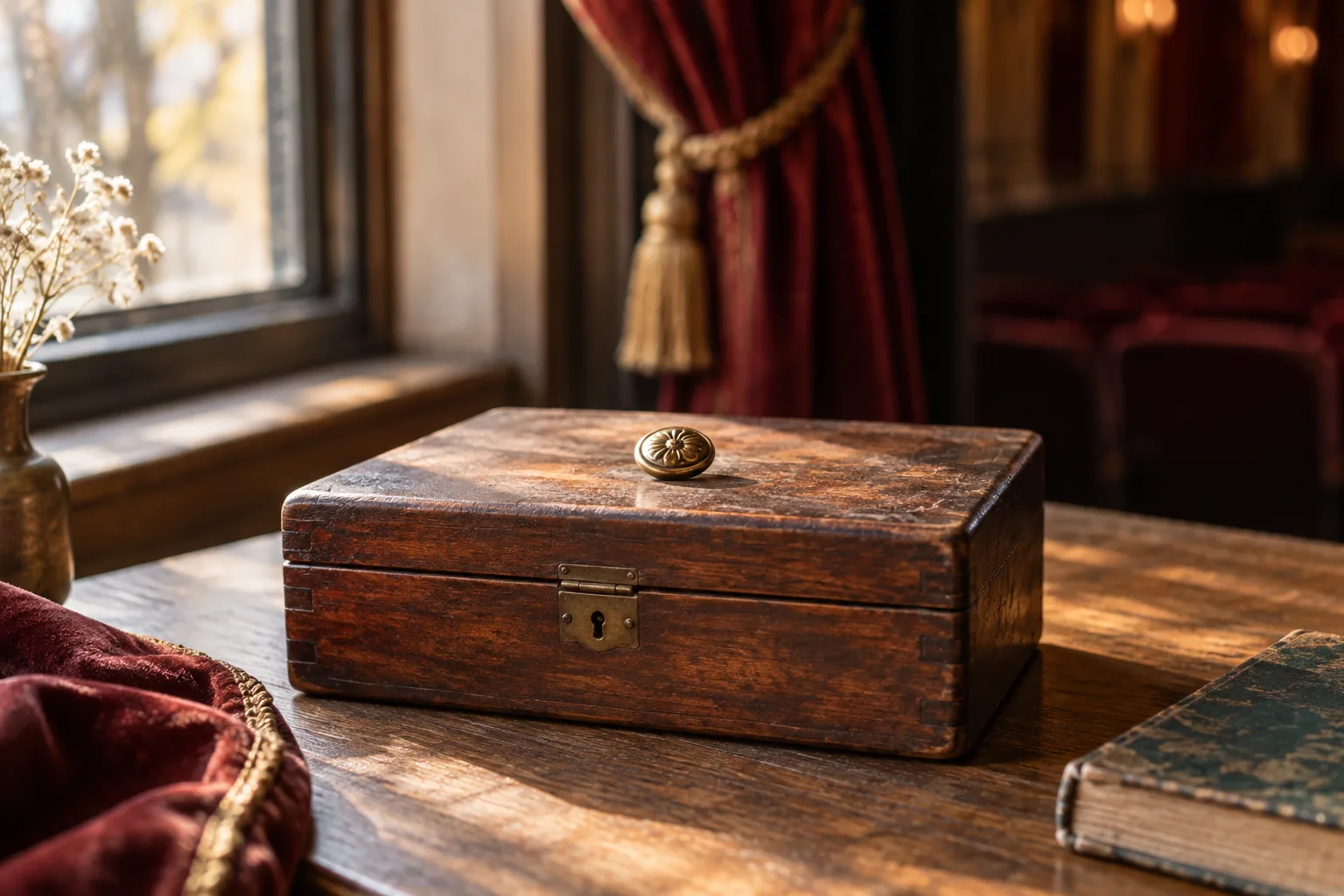
On the morning before the little theater reopened, Mara counted ninety-nine numbered admission cards and one brass button. There should have been a hundred cards in the wooden box. The button was larger than a coin, with a shallow crescent scratched into its face. It sat alone in the last compartment, as neatly placed as a reserved seat.
The cards were props for an anniversary display, not valid tickets. Mara had volunteered to arrange them beside photographs from the theater’s first season. Still, the missing card mattered: the display promised a complete set, and the opening was tomorrow. She asked Ben, the caretaker, whether someone had borrowed the last one. He shook his head and brought her the old inventory book.
The book listed the cards by their printed numbers. Beside number one hundred, someone had written a small letter C. Mara initially read it as canceled. But none of the other entries used that abbreviation, and the button looked too deliberately placed to be an accident from somebody’s pocket. Ben suggested checking the costume room, where loose buttons accumulated in jam jars.
There they found a navy coat missing one large brass button. Its remaining buttons had the same crescent pattern. Inside the collar was a stitched name: Clara. Mara looked back at the inventory mark. A letter that had seemed like a status might instead have been a person.
The coat that never reached the stage
Clara appeared in a rehearsal photograph wearing the navy coat, standing beside a painted railway carriage. The caption identified her as the understudy for the theater’s first production. Mara searched the program for her name among the opening-night cast and found it nowhere. The coat seemed to belong to a performance that had never happened.
Ben remembered Clara from his childhood. She had lived above the old stationer’s shop and mended costumes long after she stopped acting. His mother still kept a postcard from her. He fetched it during lunch, apologizing for the ordinary message about rain and a broken umbrella. Mara almost handed it back before noticing the final line: “I kept my seat, even if I never used the coat.”
A seat, not a role. Mara returned to the admission cards and noticed that the hundredth compartment was slightly wider than the others. Beneath its velvet lining lay a folded seating plan. One chair in the front row was circled. The handwritten note beside it read: “Clara’s guest, every opening.” The button had been a marker for a promise, not a substitute ticket.
They still needed the card itself. Ben checked the old photograph albums while Mara examined the plan’s fold marks. A rectangle had left a pale impression inside the paper, showing that something had once been stored there. Whoever moved it had preserved the plan and button together. The search now had a narrower question: who had needed proof of that reserved seat?
A place in the audience
The answer came from Ben’s mother, who arrived carrying a small envelope rather than another album. Clara had given her the final card years earlier. It was tucked behind a photograph of two women outside the theater, one holding the navy coat over her arm. The other was Ben’s grandmother, who had paid for the production’s missing scenery when the company ran out of money.
Clara had arranged a permanent opening-night invitation in thanks. When Ben’s grandmother could no longer attend, she passed the card to her daughter. The button stayed in the ticket box because it was the company’s private reminder of Clara’s promise. The scratched crescent was not damage after all; the same mark had been added to every button so the coat would catch the stage lights.
Mara asked whether the family wanted to lend the card for the display. Ben’s mother agreed on one condition: the invitation should not be described as an unused ticket. It had been used in a way the printed number could not record. For years, someone had known there would be a place for her if she could come.
The next evening the display held all one hundred cards, with the button beside the last. Mara left the circled front-row seat available until the house lights dimmed. Ben’s mother arrived with a friend and sat down smiling. The restored theater had recovered more than a complete collection. It had remembered how to keep a place for someone.