The outline is not the object
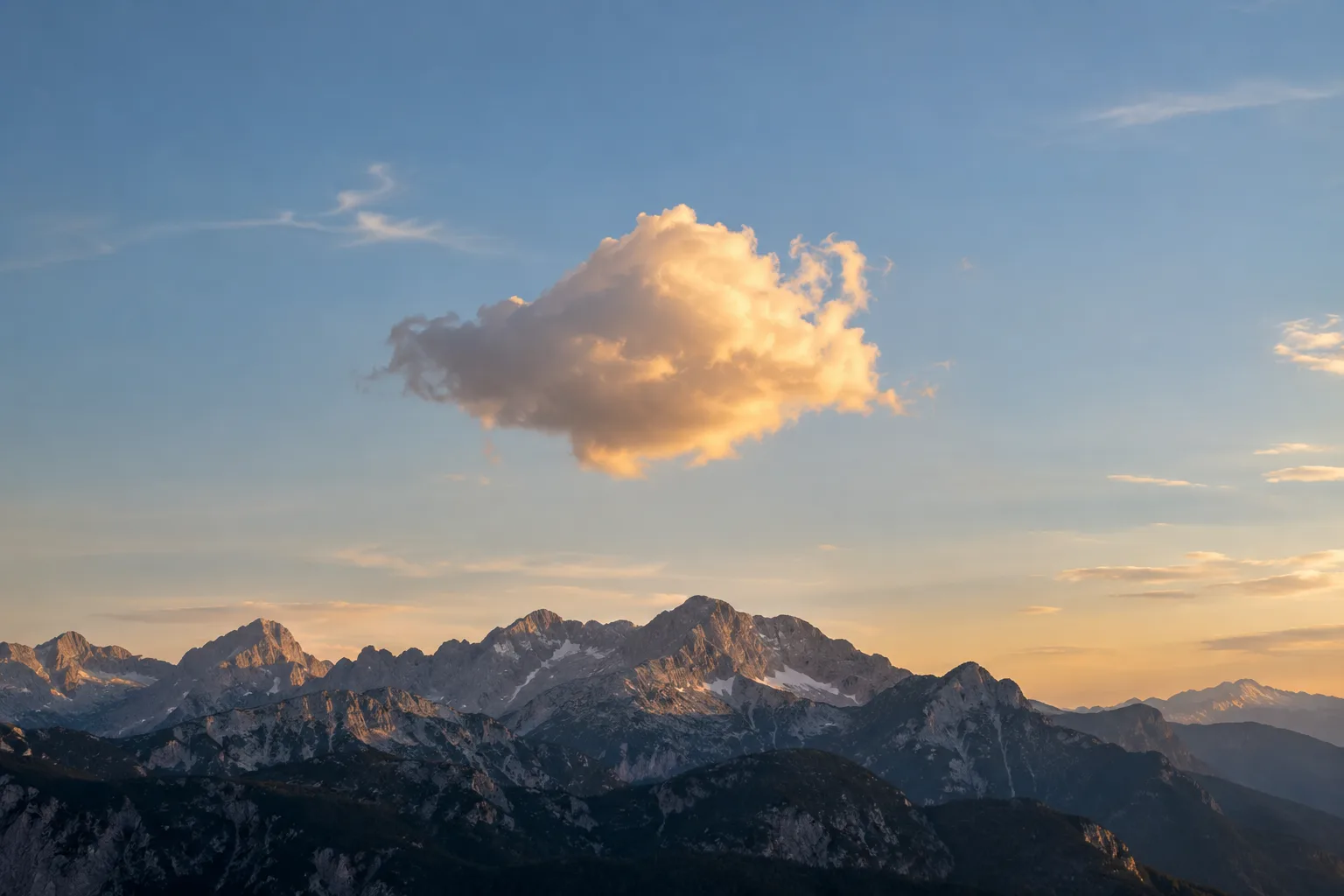
Imagine watching a cloud above a ridge while the grass around you bends in the wind. Ten minutes later, the cloud seems to occupy much the same place. It is tempting to picture a soft object parked in a quiet pocket of sky. But a cloud’s visible boundary is not a container, and its outline does not identify a fixed collection of water droplets.
NOAA explains that visible clouds contain liquid droplets or ice crystals. Water vapor, the gaseous form, is invisible. That difference is easy to lose in everyday descriptions of a cloud as a mass of vapor. What the eye sees is water that has condensed or frozen into particles capable of scattering light, not all the moisture in the surrounding air.
A useful way to frame the observation is to ask two separate questions. Where are conditions allowing a cloud to be visible, and what is the air doing as it passes through that region? Those questions can have different answers. The apparent position of a shape alone cannot establish whether its constituent material is staying put.
This is a thought experiment rather than a report of one particular cloud. It prepares us for a real atmospheric pattern: clouds associated with waves near mountains. To understand that pattern, the important next step is to follow moving air instead of treating the bright outline as a solid object.
A shape renewed by moving air
Air flowing across terrain can be displaced upward and downward in waves. NOAA’s National Weather Service describes standing lenticular clouds as a feature that can develop when stable, sufficiently moist air moves over a topographic barrier. The cloud can appear nearly stationary even while the wind passing through it is moving rapidly.
The mechanism connects motion with changing conditions. Air rises and cools in part of the wave, allowing condensation when saturation is reached. Farther along, descending air warms and the visible cloud can evaporate. The cloud’s position reflects the part of the flow where cloud formation is favored. Air continues onward through the pattern.
A line of people moving through a doorway offers a limited analogy. The doorway remains in place while the people change. A cloud has no wooden frame and the atmosphere is far more complicated, but the comparison helps separate a persistent location from the identity of what passes through it. The still-looking shape need not be made of still air.
NOAA satellite explanations also describe wave clouds appearing in repeated bands as air alternately rises and sinks. Yet not every cloud above a mountain is lenticular, and a single pretty photograph should not be used to force a classification. The larger arrangement, motion, and atmospheric conditions matter. A mountain is a clue to investigate, not a label that automatically explains everything overhead.
What disappearance really means
When a cloud edge fades, water has not necessarily fallen to the ground. NOAA’s cloud-formation explanation describes a balance between condensation and evaporation: a cloud can dissipate when evaporation exceeds condensation. The visible feature can shrink as water returns to an invisible gaseous state. The atmosphere still contains water even where the eye sees blue sky.
Rain is a different development. Cloud droplets and ice particles must grow sufficiently for precipitation to emerge; the presence of a cloud alone is not proof that rain will reach a particular observer. NOAA’s precipitation guidance describes processes such as droplets combining and ice particles growing. Following those processes is more informative than assuming that every fading cloud has emptied like a bucket.
The distinction also limits what a clear gap tells us. The National Weather Service notes that mountain waves can exist when the air is too dry to form a visible cloud. Absence of a lens-shaped cloud is therefore not evidence that the flow is smooth. The visible sky is a partial display of conditions, not a complete map of every movement.
The original puzzle now has a satisfying answer. Something can look unchanged because the process maintaining it continues, rather than because nothing is happening. Watch a cloud’s edge with that possibility in mind and the sky becomes less like a collection of floating objects. It becomes a changing pattern made visible for as long as local conditions support it.
All 3 chapters
Sources & further reading
Checked . Explanation and commentary are original; factual claims draw on these primary sources.