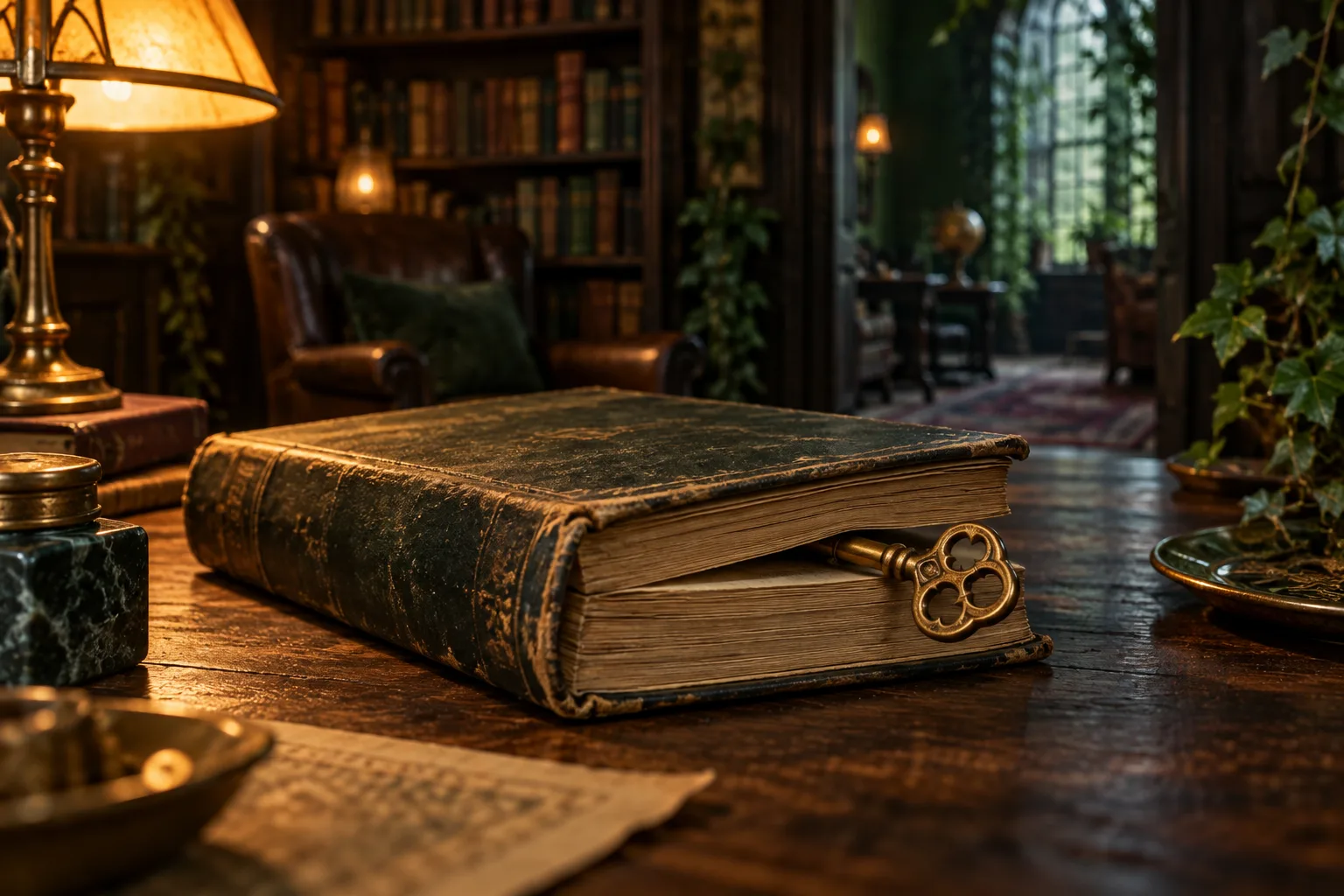
The book nobody had borrowed
Mara found the key while sorting the last donation box of the afternoon. It dropped from a book of coastal maps, struck the desk and settled beside her cold tea. A paper tag was tied to its bow with blue thread. On one side was a number: 17. On the other, in careful pencil, someone had written, “Return it before the last Thursday.” The month was missing. So was the year.
The little library in Bellweather had no drawer numbered seventeen. Mara checked anyway, working through the circulation desk and the battered cabinet in the staff room. Outside, rain made the windows look silver. Inside, the building offered its familiar noises: the pipes, the clock and the wheels of a cart pushed by Mr. Vale, who volunteered on Thursdays because he said every other day was already spoken for.
He stopped when he saw the blue thread. Not the key, Mara noticed. The thread. “Where did you get that?” he asked. She pointed to the maps. He ran a finger along the spine without opening it, then looked toward the boarded door behind the local-history shelves. Mara had always assumed it concealed a cupboard. Mr. Vale took off his glasses. “That used to be the entrance,” he said. “Before we agreed to forget what was down there.”
Seventeen was not a room
The door opened onto a staircase and a smell of dust rather than danger. Mr. Vale insisted on bringing a torch. In the cellar, shelves held obsolete signs, broken chairs and a wooden card catalogue rescued from the old railway station. Each drawer had a little brass number. Seventeen had been polished clean, though its neighbors wore a dull brown film.
The key turned easily. Inside was a photograph of six teenagers beside a station clock, a packet of letters and a folded programme for a concert that had never taken place. Mara recognized the youngest face in the photograph as Mr. Vale. The girl beside him held a violin case. “My sister, June,” he said. “She was going away to study. We promised to come here once a year and leave a letter for each other. News we were too embarrassed to say aloud.”
Mara lifted the packet only after he nodded. Every envelope was addressed to June. None had a stamp. Mr. Vale explained that an argument had split the group before the first reunion. June had left town; the others had assumed she no longer wanted their letters. Eventually, the station closed and the cabinet came to the library. The concert programme concealed one more envelope. Its paper was fresh. The handwriting matched the tag. “I will be here on the last Thursday,” it said. “If anyone remembers.”
The person at the door
It was the last Thursday of the month. Mara checked the time, then the donation ledger. The maps had arrived that morning in a box left by a woman who had asked when the library closed. Mara had answered without looking up. For the first time all afternoon, the ordinary clock above the desk sounded unreasonably loud.
They found June on the bench outside, holding an umbrella with a broken rib. She had not left a puzzle to punish them, she explained. She had put the key in the book Mr. Vale used to borrow, hoping the sight of it would make an invitation easier than a confrontation. She had expected him to recognize the title. She had not expected a new librarian to open it first.
Mr. Vale sat beside her, leaving room for the packet between them. He did not begin with an explanation for all the missing years. He asked whether she still played. June laughed, then cried, then said that she taught now. Mara went inside to make fresh tea. Through the window, she watched them open the oldest envelope together. Later, drawer seventeen returned upstairs and became a place for the town’s oral-history recordings. Its first entry began with two voices disagreeing about the same concert, and then laughing. Mara kept the blue thread tucked into the ledger. The key stayed in the lock.