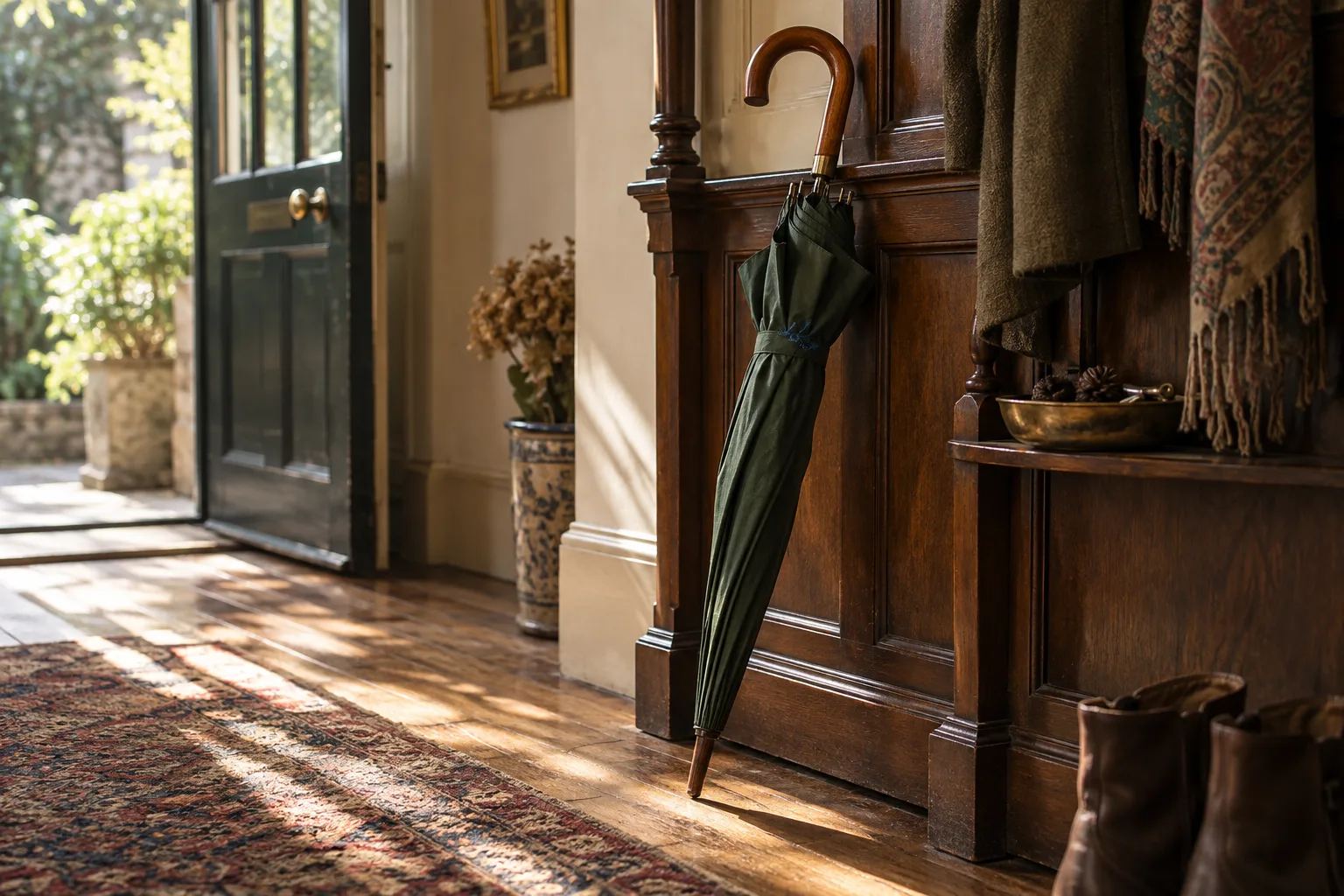
The wrong place, three mornings running
On Monday, Mara found the green umbrella on the third hook inside the village hall. On Tuesday, it was there again. By Wednesday, she had stopped blaming her own memory. Each evening she had moved it to the lost-property cupboard, and each morning it returned to the same hook, neatly fastened, with its curved handle pointing toward the window.
The umbrella was ordinary except for a repair along one panel: six bright blue stitches against dark green cloth. Mara photographed the stitches before putting it away that night. She was preparing an exhibition of old village photographs, and borrowed objects had already begun arriving without labels. Perhaps someone thought the umbrella belonged in the display. But nobody had left a name.
She asked the choir leader, who used the hall on Monday evenings. He remembered a green umbrella, but his had a straight handle. The gardener had a key, too, though he said he had not entered the building that week. Neither explanation accounted for the object returning after Mara locked the cupboard and placed its small brass key in her desk.
Then she noticed something in Wednesday's photograph. A thin gray smear marked the handle near the curve. The hall's newly painted hooks were cream, not gray. Somewhere between cupboard and hook, the umbrella had touched a surface she had not considered. Mara decided to follow that modest clue before inventing a grander explanation.
A clue that belonged to the building
The gray paint matched the narrow door beside the stage. Mara had forgotten that the lost-property cupboard had once been a serving hatch. From the office it looked like a normal cupboard, but its rear panel opened into the stage passage. The little brass key had secured only one side. Nothing supernatural, and no duplicate key, was required.
In the passage she found a folding chair, a mug with a chipped handle, and a tin containing blue thread. A handwritten schedule lay beside the mug. The hall committee had arranged early-morning deliveries for the exhibition, and a volunteer named Ellis was receiving them before Mara arrived. His name appeared on all three mornings when the umbrella had moved.
Mara waited the next day, determined to ask rather than accuse. Ellis arrived carrying a flat parcel and wearing a raincoat several sizes too large. When she showed him the photograph, he recognized the umbrella immediately. He had put it on the third hook because that was where his mother used to leave it when she worked in the hall kitchen.
But his mother no longer lived in the village, and Mara had never met her. Why had Ellis brought the umbrella now, and why had he kept retrieving it without a word? He looked toward the unopened parcel. He had assumed, he said, that the object would explain itself when the photograph arrived. The delivery had been delayed.
The photograph that supplied the missing label
Inside the parcel was a photograph of the hall entrance on a wet afternoon. A younger version of Ellis's mother stood beneath the green umbrella, holding it over two children while rain darkened her own sleeve. The third hook was visible through the doorway. On the back, she had written the year and the names of the children: Ellis and Mara.
Mara remembered the afternoon before she remembered the face. Her father had been late collecting her from a painting class, and a woman from the kitchen had waited with them in the rain. Mara had torn the umbrella with the corner of her picture frame. The woman had laughed, found blue thread in the costume box, and let both children help mend it.
Ellis had asked his mother for something to lend the exhibition. She sent the umbrella ahead with him and promised the photograph separately. He thought placing it on its old hook would preserve the scene she remembered. When it disappeared each evening, he assumed Mara was clearing the entrance for events. Neither had realized the other was trying to be helpful.
They gave the umbrella a proper label and displayed it beside the photograph. The six blue stitches were uneven, three made by each child. Mara left the cupboard locked but added a note to its rear panel. That evening, the third hook stayed empty for the first time all week. Nothing was missing anymore; the object had finally found its story.