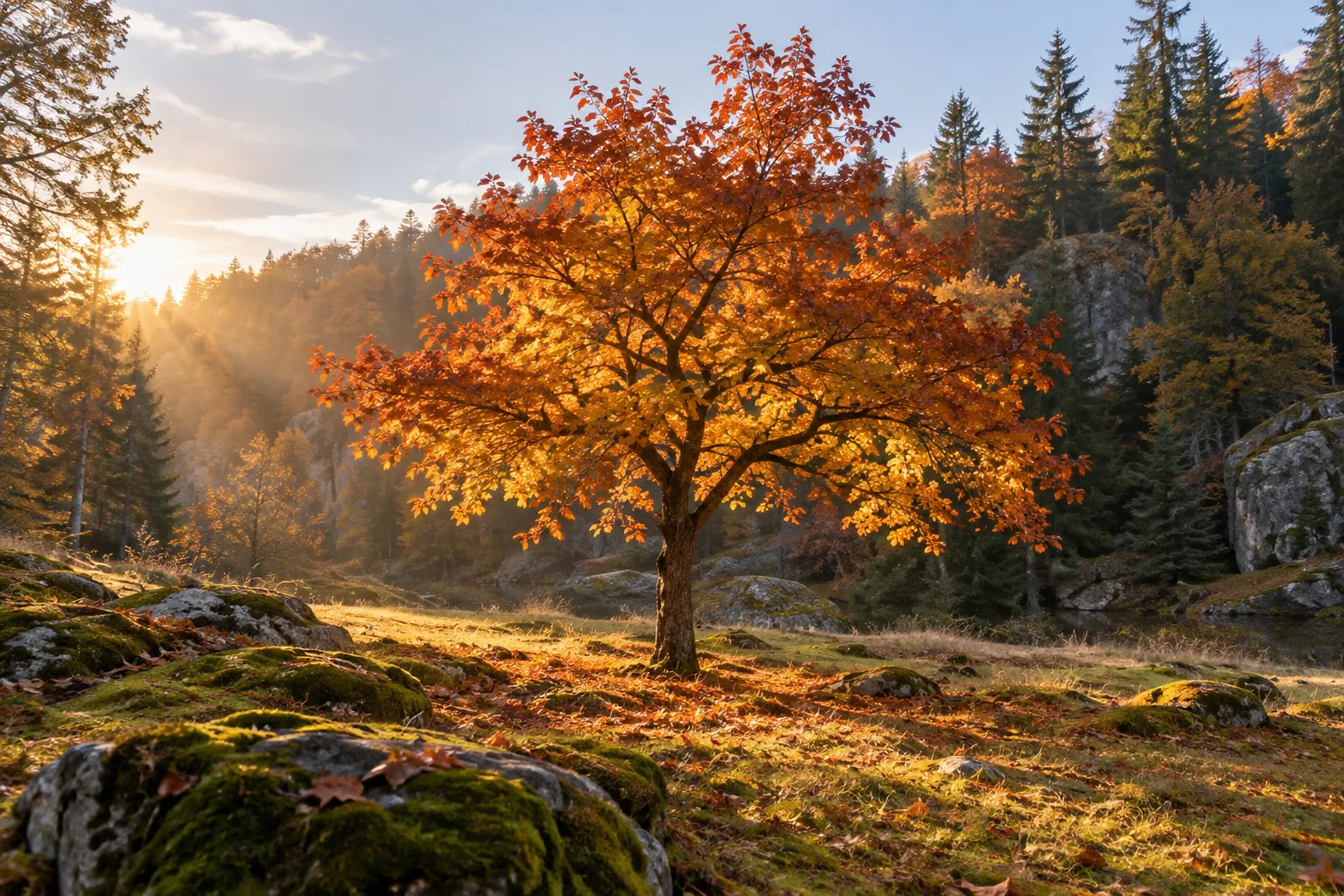
The green was never the whole picture
A yellow leaf can make autumn look like a fresh coat of paint. Yet part of the change is a reveal: colors that were less visible while green dominated become easier to see. The National Park Service describes chlorophyll breaking down as the season changes, allowing other pigments to stand out. A leaf's appearance depends on a mixture, not just one color ingredient.
During the growing season, chlorophyll supports photosynthesis, the process by which plants use light to help make sugars. Its familiar green appearance can mask carotenoids, which contribute yellows and oranges. Losing some of that green therefore changes the balance of what we see. The leaf need not manufacture every visible autumn color from scratch on the day it catches your attention.
That is a useful correction to an everyday impression, but it is not a complete explanation of every autumn leaf. Reds and purples involve another pigment group, anthocyanins. Treating all colors as though they were simply hidden under green would miss part of the chemistry. The next question is which pigments are present, and how their amounts change.
Think of a branch with green, yellow, and red areas as evidence of a process unfolding unevenly. The colors invite investigation rather than a single verdict. A photograph can preserve a striking moment, but it cannot by itself tell you the entire history of the pigments, the tree, or the conditions around that branch.
Why one canopy can contain several autumns
NPS explains that shorter days and cooler temperatures help signal seasonal changes in many deciduous plants. But a seasonal signal does not make every leaf follow an identical timetable. Sunlight, moisture, temperature, elevation, and the characteristics of the plant all influence the display. Neighboring trees can share a street while differing in both species and immediate growing conditions.
Anthocyanins add another layer to the story. These pigments can contribute reds and purples, and their development is connected with the sugars and conditions in leaves. A useful way to think about the canopy is as a changing mixture of pigment production, pigment breakdown, and local circumstances. That is more informative than imagining a tree choosing one replacement color for all its leaves.
Researchers have tested these relationships rather than relying only on scenic observations. A study published in 2001 followed leaf tissue from sixteen sugar maples during the 1999 growing season. Its abstract reports associations between measured leaf properties and the timing and quality of color, while explicitly noting that further work was needed to establish causal influences.
That qualification matters. A correlation in one study is not a universal recipe for a perfect red tree. The research helps show why the question is richer than a calendar date or a cold night. For someone looking at a woodland, the practical insight is to expect variation and to distinguish a broad seasonal pattern from a precise explanation of one leaf.
A season is not an appointment
People understandably ask when autumn color will peak. The Blue Ridge Parkway's NPS guidance explains why there is no simple formula for an exact date at a particular location. Plant genetics and environmental conditions interact, and a landscape with different elevations and species does not change all at once. A regional tendency is useful without being a promise about one overlook.
This also changes what it means to watch the season closely. A single bright tree does not establish that every surrounding tree is at the same stage. A dull-looking morning may reflect the light as well as the leaves. Those are reasons to compare observations carefully, rather than forcing a complicated landscape into one label such as early, late, or finished.
The process continues beyond the colorful photograph. NPS describes trees recovering nutrients from leaves before they fall. That seasonal transition connects the visible display with the tree's ongoing life. The leaf is not merely an ornament that becomes irrelevant when its green color fades; it has been part of a living system throughout the change.
The satisfying answer to why leaves change is therefore a set of connected answers. Pigments differ, their balance changes, and trees respond to both seasonal signals and local conditions. Once you know that, the unevenness becomes part of the interest. The branch that seems out of step with its neighbors is another chance to look more closely.
All 3 chapters
Sources & further reading
Checked . Explanation and commentary are original; factual claims draw on these primary sources.