A route without street names
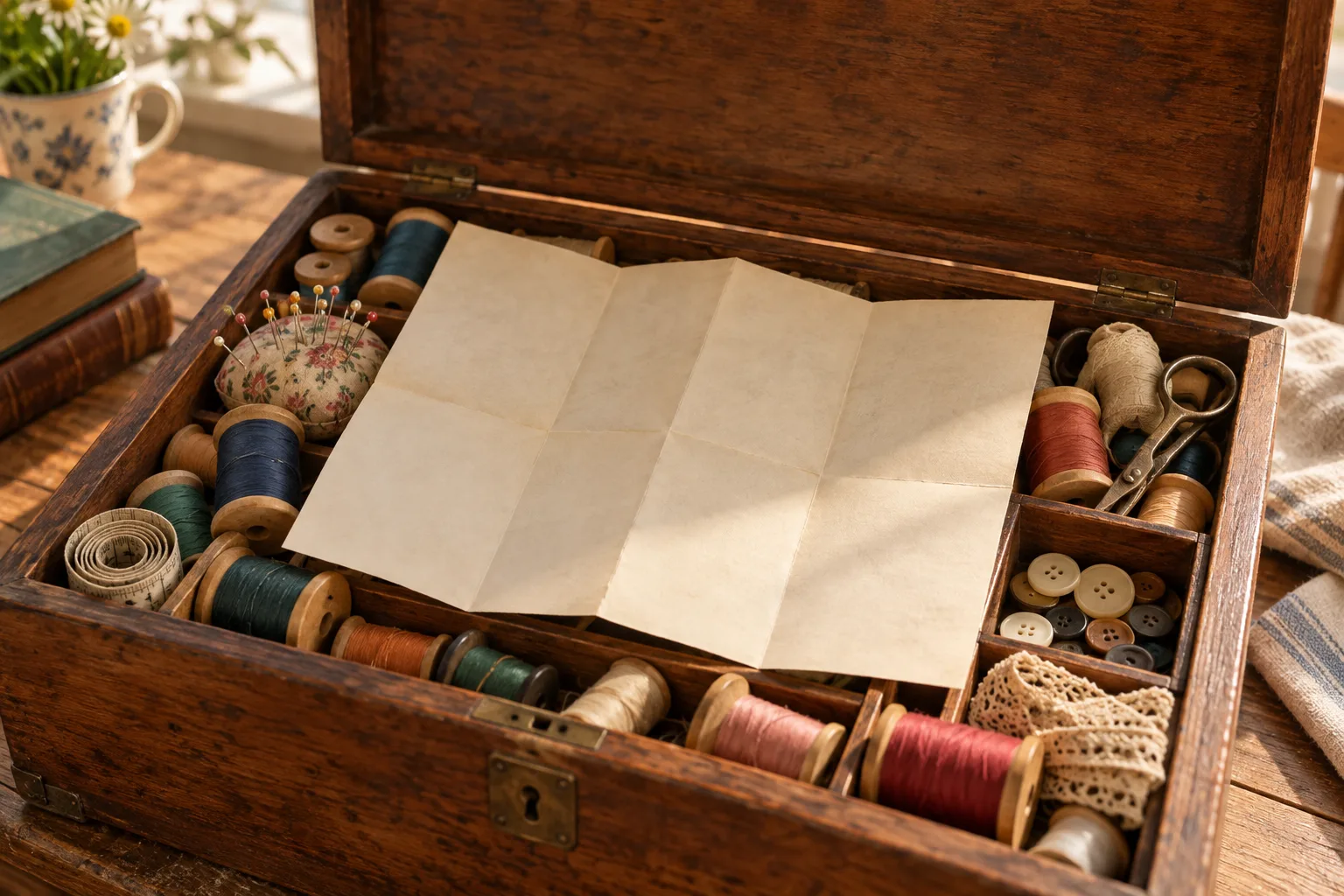
Nora found the folded paper beneath a tray of wooden spools while preparing her aunt’s sewing box for the village exhibition. At first she thought it was a dress pattern. There were long lines, short cross marks, and a row of small circles. Then she noticed an arrow and three words in her aunt’s handwriting: start at home.
The paper contained no street names, but its longest line looked like the road past the old mill. Nora carried a copy outside and tried following it. The first turn took her to the baker’s delivery gate. The second pointed through a hedge. By the third, the route would have crossed the river where no bridge had ever stood.
Her aunt, who now lived with Nora’s cousin, laughed when she heard the description over the telephone. She remembered making a map, but not that one. There had been so many lists during the last months before the workshop closed. She asked Nora to leave the sewing box intact until she could visit on Sunday.
Nora agreed, then looked again at the original. One of the circles was not drawn in ink. It was a small hole surrounded by a faint rust-colored ring. Every other circle had a similar mark. Whatever the paper described, someone had once pinned it down carefully, and the longest line ended exactly at a fold.
The wrong kind of distance
On Saturday, Nora brought the paper to the exhibition committee’s worktable. Sam, who was mounting photographs, suggested an old garden plan. The circles could be trees. They compared it with a picture of the workshop garden, but the proportions refused to fit. The paper had six circles along one edge; the photograph showed only two fruit trees.
Then Sam turned the paper over to check for a date. Across the back ran shallow impressions, as if someone had traced a second drawing above it. Nora held it toward the window. The lines repeated those on the front, but with small offsets. A narrow strip along one side was marked with several different lengths.
She remembered watching her aunt fit costumes for the summer pageant. Pins had traveled constantly between her fingers, a cushion, and the table. Nora returned to the sewing box and lifted the tray again. Under the lining was a flat cardboard rectangle, neatly cut at two corners. Its edges matched the folds in the paper.
The discovery did not yet explain the arrow or the instruction. Nora stopped trying to assign the lines to streets. She laid the paper flat, placed the cardboard beside it, and photographed both without rearranging the spools. For the first time, the useful question was not where the map led. It was what had once stood on top of it.
A place for every borrowed thing
Her aunt arrived on Sunday carrying a small cloth bag. Before looking at the paper, she asked whether the exhibition had enough sewing tools for its children’s table. Nora said they had scissors and rulers but no plan for keeping track of them. Her aunt smiled and emptied the bag: six old wooden pegs, each worn smooth at the top.
The paper was a layout for a portable sewing station used during pageant rehearsals. The cardboard had covered the bottom of a shallow box. Pegs stood through the six marked holes to hold borrowed spools. The long lines showed where rulers, scissors, and folded tape measures belonged. Home meant the outline to which each item should return.
The offset impressions recorded later arrangements for different groups of children. Her aunt had called it a map because newcomers could find what they needed without asking her every minute. She had forgotten the particular sheet, but the pegs brought back the crowded rehearsal room, the last-minute hems, and the pleasure of seeing the table put right.
Nora mounted a copy beside the sewing box and left the original folded safely inside. At the exhibition, the children arranged their supplies on a new version of the map. There was no buried treasure and no journey across the river. The route led to something smaller and more useful: a place where everyone could find what belonged to everyone.