The wrong kind of distance
On Saturday, Nora brought the paper to the exhibition committee’s worktable. Sam, who was mounting photographs, suggested an old garden plan. The circles could be trees. They compared it with a picture of the workshop garden, but the proportions refused to fit. The paper had six circles along one edge; the photograph showed only two fruit trees.
Then Sam turned the paper over to check for a date. Across the back ran shallow impressions, as if someone had traced a second drawing above it. Nora held it toward the window. The lines repeated those on the front, but with small offsets. A narrow strip along one side was marked with several different lengths.
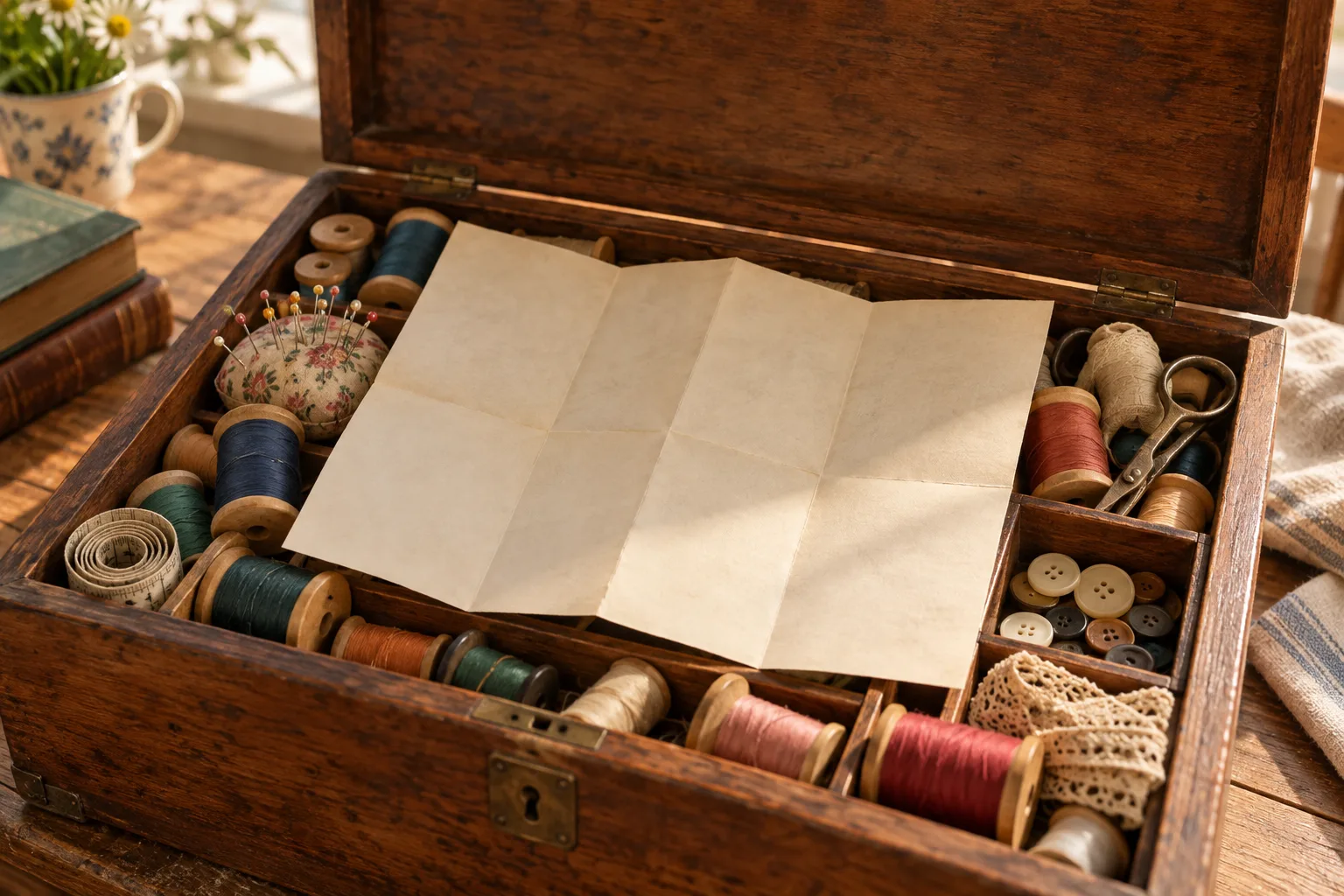
She remembered watching her aunt fit costumes for the summer pageant. Pins had traveled constantly between her fingers, a cushion, and the table. Nora returned to the sewing box and lifted the tray again. Under the lining was a flat cardboard rectangle, neatly cut at two corners. Its edges matched the folds in the paper.
The discovery did not yet explain the arrow or the instruction. Nora stopped trying to assign the lines to streets. She laid the paper flat, placed the cardboard beside it, and photographed both without rearranging the spools. For the first time, the useful question was not where the map led. It was what had once stood on top of it.