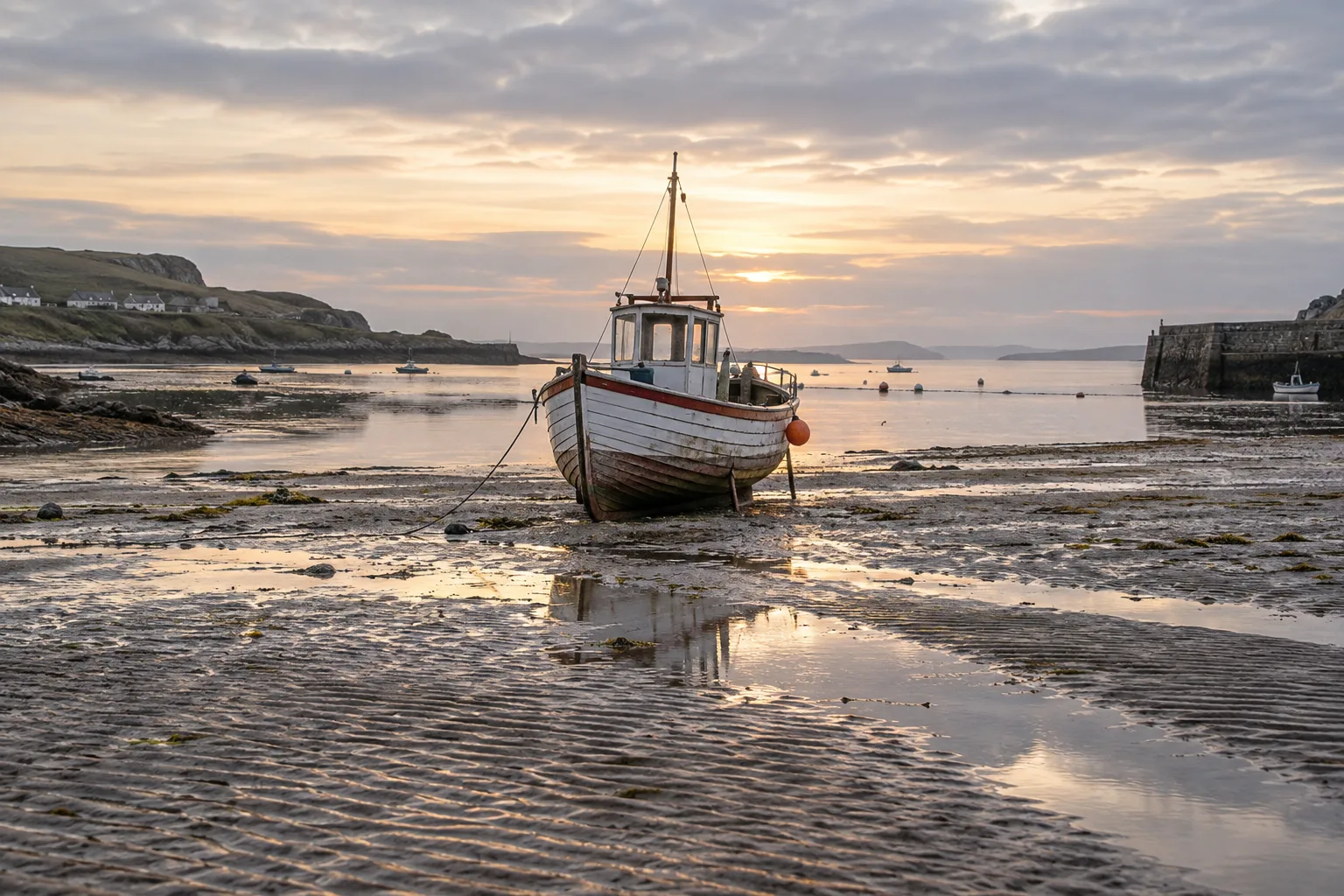
The photograph leaves out the clock
Imagine two photographs of the same small harbor. In one, a boat floats above its reflection; in the other, it sits beside exposed mud and a narrow channel. There need not be a broken seawall or a sudden drought between those frames. The missing information may simply be the time. This imagined comparison is a useful starting point because a shoreline is not a permanent line painted around the land.
NOAA describes tides as the long-period rise and fall of the sea surface, driven by the Moon and Sun. High tide and low tide are the upper and lower parts of that changing level. Their height difference is the tidal range. A broad beach can make the change look especially dramatic, but the distance exposed across the ground and the vertical height difference are two different measurements.
Now picture marking the water level against a fixed harbor post. That gives you a reference you can compare between visits. Watching a patch of foam drift past the post tells you something else: the water is moving horizontally. NOAA distinguishes that motion, a current, from the changing level of the tide. Both can appear in the same scene. Separating them is the first useful step toward reading the harbor as a process instead of treating each photograph as a different place.
One Moon, several coastal rhythms
The familiar classroom picture puts two bulges of water on opposite sides of Earth. NOAA's explanation relates this to differences in the Moon's gravitational pull across the planet; the Sun contributes as well. The picture is an introduction to the forces, not a complete map of today's shoreline. Real oceans have continents in their way. Their basins respond in patterns that the tidy sketch cannot show.
NOAA identifies three common coastal patterns. Semidiurnal tides have two comparable highs and two comparable lows per lunar day. Mixed semidiurnal tides have two of each with unequal heights. Diurnal tides have one high and one low. That is why a confident claim that every beach empties twice a day goes too far. Before interpreting a place, first establish which pattern it actually follows.
There is a second rhythm within the month. Near new and full Moon, the combined astronomical effects produce the larger ranges called spring tides. Near quarter phases, the range is smaller: neap tides. Spring is not a seasonal appointment. Imagine comparing two weeks of sketches made from that same harbor post, with dates and times beside them. You would be asking two separate questions: how often does the water rise here, and how large is the change? Keeping those questions separate turns an apparently inconsistent coast into something you can start to understand.
The useful answer is local
A tide chart becomes most interesting when you remember that it describes a particular place. NOAA explains that shoreline shape, bays, and estuaries can alter tidal magnitude. Weather adds another complication: wind can move water toward or away from shore, and atmospheric pressure also affects the observed level. Knowing the astronomical pattern therefore does not remove the need to know what is happening locally.
This is not merely a distinction for people collecting beach photographs. NOAA describes the importance of both water height and current information for navigating shallow ports, planning coastal structures, and restoring habitats. A ship's clearance and the force carrying it sideways are different concerns. The agency also describes real-time measurements used in major ports alongside predictions. Observation remains valuable even when the underlying cycle is well understood.
The satisfying end to the disappearing-shoreline puzzle is that no single dramatic cause is needed. There is a recurring astronomical influence, a particular shape of coast, and the conditions present on the day. The boat in our imagined photographs occupies one place in that larger system. On your next look at a harbor, try noticing a fixed reference point rather than just the water's edge. A mark on a post, the base of a stair, or the exposed part of a wall makes the change readable. The scene becomes richer once you can see the clock that a still photograph leaves out.
All 3 chapters
Sources & further reading
Checked . Explanation and commentary are original; factual claims draw on these primary sources.