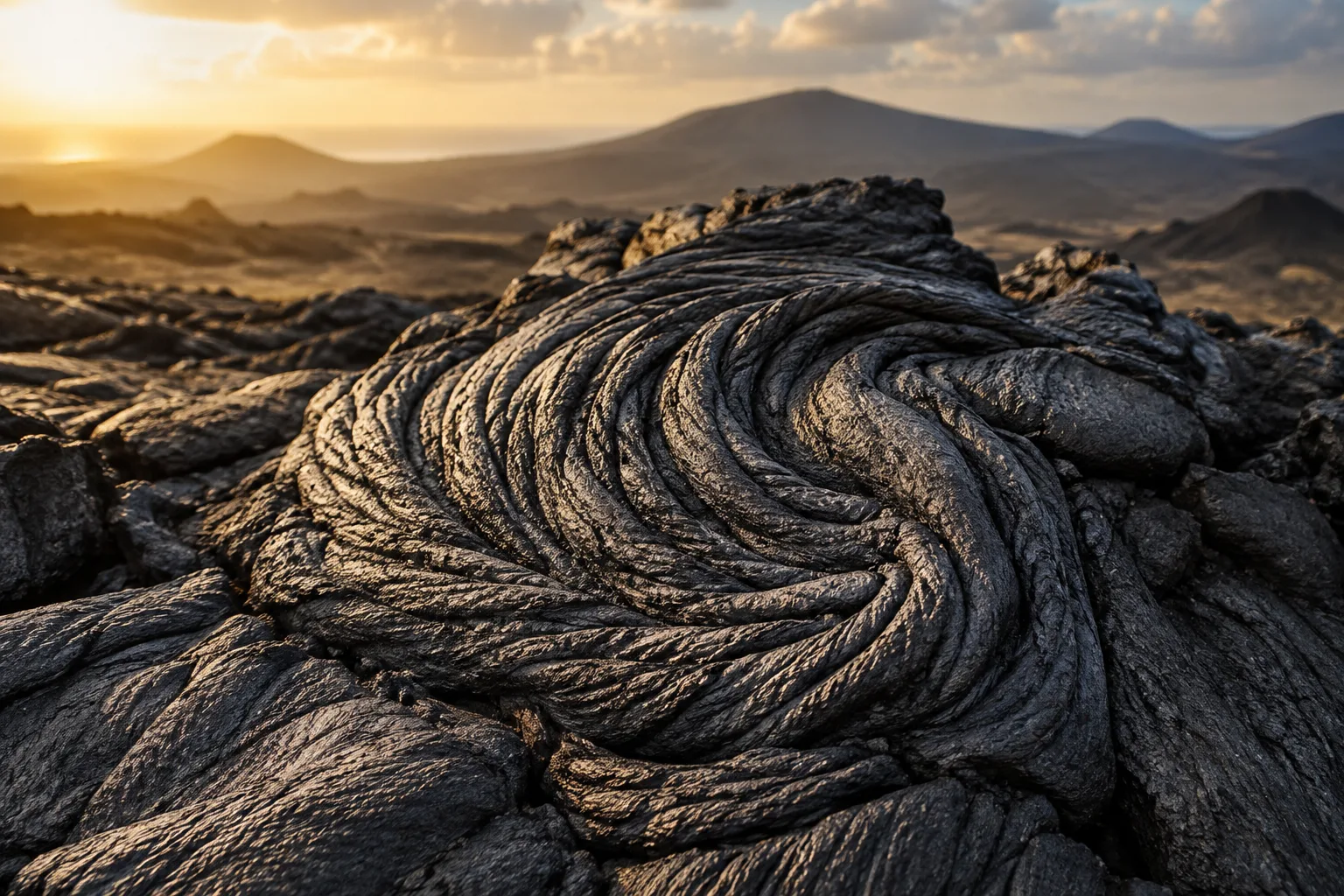
The mountain is an accumulation
Ask someone to sketch a volcano and a steep triangle may appear almost immediately. It is a powerful visual shorthand: a mountain, an opening, perhaps a cloud. But a shorthand can quietly become a rule in our imagination. If we expect every volcano to fit that drawing, we can miss the broad slopes and less theatrical forms that belong to the same geological story.
The US Geological Survey describes volcanoes as being built from their own erupted materials. It also distinguishes magma, below the surface, from lava after eruption. Those definitions shift the emphasis from a mountain that happens to contain fire to a system that moves material and builds a landscape. The visible form is an outcome, something assembled through events, rather than a standard container waiting to be filled.
USGS descriptions of volcano types make the contrast concrete. Fluid lava flows spread widely to build the gentle profile of a shield volcano. Composite volcanoes, also called stratovolcanoes, combine layers of lava and fragmented erupted material into generally steeper forms. You do not need to memorize a catalog of names to find the idea useful. Imagine reading the silhouette as a question: what kinds of material could accumulate into that shape? The answer turns the outline into evidence. A mountain photograph becomes the beginning of an investigation rather than the whole explanation.
Ash is a misleadingly familiar word
The word ash invites an everyday comparison with a fireplace. In a volcanic setting, that comparison can lead us astray. USGS describes volcanic ash as small fragments of rock, minerals, and volcanic glass. It is not the soft residue left after wood burns. A familiar label has crossed into a different process, and the distinction matters for understanding what an eruption has actually produced.
USGS explains that expanding gases can break apart magma and rock during explosive eruptions; interactions with water can also contribute. The agency's discussion of eruption styles considers magma composition, temperature, crystals, gases, and water interaction. That list is a useful antidote to judging an eruption from one dramatic image. A bright flow and a high cloud are not simply two camera angles on an identical process.
Other volcanic terms separate mixtures that might otherwise blur together. A lahar combines water and volcanic debris. A pyroclastic flow is a hot, rapidly moving mixture of gas and fragments. Neither is just another name for liquid lava. Think of the vocabulary as a set of questions about ingredients and motion: what is moving, what carries it, and how did it form? The goal is not to make a photograph sound more technical. It is to stop a single word, or a familiar-looking cloud, from concealing several very different physical events.
The part a photograph cannot show
Understanding a volcano also requires evidence that a visitor cannot simply see in its outline. The USGS Cascades Volcano Observatory describes monitoring across several disciplines, including earthquakes, ground deformation, and volcanic gases. A change in the surface's position and a change in gas output offer different kinds of information. Neither is a literal window into the entire underground system.
The breadth of that work is visible in the USGS monitoring recommendations first published in 2024. The report includes chapters on seismic techniques, ground deformation, gases, surface changes, and other measurements. The point is not that every instrument answers the same question more expensively. Different observations help constrain different processes. Putting them together supports interpretation, while a single unusual signal still needs context.
Return to the simple cone drawing. It remains a perfectly good symbol, but it no longer has to do all the explanatory work. The shape records accumulated material; the fragments reveal processes; measurements help scientists investigate change. Those are three different ways of reading the same system. The payoff is a more interesting volcano, even in a quiet landscape photograph. Instead of waiting for the most dramatic moment, we can ask what the existing rock and the ongoing measurements already reveal. The mountain is the visible part of a story, and learning to read it means leaving room for the parts outside the frame.
All 3 chapters
Sources & further reading
Checked . Explanation and commentary are original; factual claims draw on these primary sources.