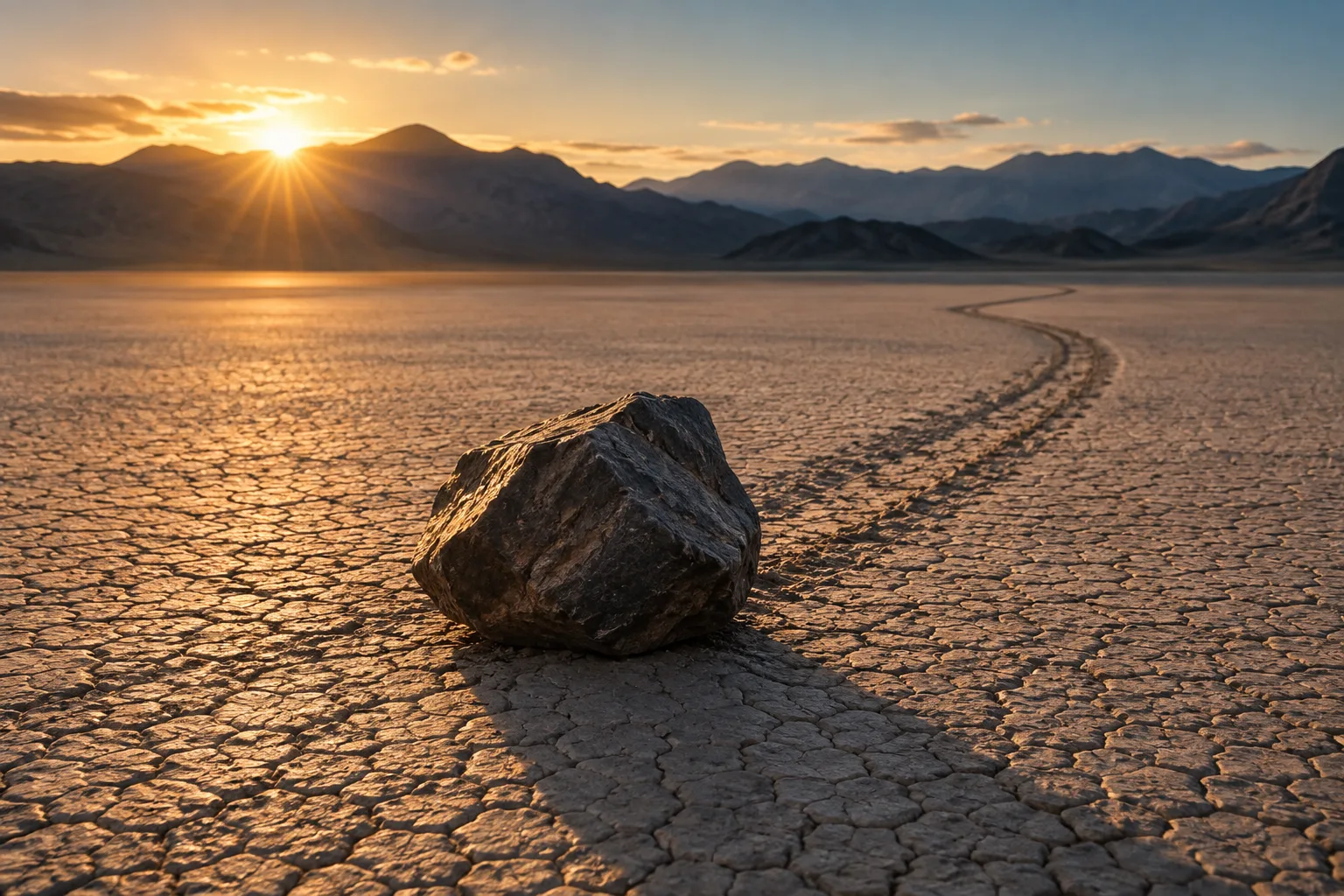
A landscape with evidence, but no witness
A rock at the end of a long trail is a wonderfully awkward object. It looks like the final frame of a film whose earlier scenes have gone missing. On the dry surface of Racetrack Playa in Death Valley, that impression comes from something real: stones have left tracks across the lakebed, sometimes in patterns that look coordinated. The National Park Service describes hundreds of rocks and trails that can extend for hundreds of meters. Some stones remain still for years.
The temptation is to start with a dramatic explanation. A hidden hand, perhaps, or a wind powerful enough to send a boulder skating. But a trail alone does not tell us what conditions existed when it formed. Dry ground in a photograph need not have been dry during the event. A still landscape can preserve the aftermath of a brief transformation.
That distinction makes this more than a strange travel photograph. It is a compact lesson in reading evidence: the thing we can see may be a record of a situation we cannot. Ask what would need to change around the rock, rather than assuming the rock did something extraordinary. The answer, as observations eventually showed, involved a very ordinary material behaving at just the right moment.
The ice was thinner than you might expect
In research published in 2014, Richard Norris and his colleagues described direct observations using instrumented rocks, photography and weather measurements. Their observed mechanism involved thin ice on shallow water. As the ice began to melt and break into floating panels, light winds moved those panels, which pushed rocks across the wet surface. The reported ice was only about three to six millimeters thick. This was not a scene of stones racing across bare, sun-baked ground.
The study reported slow motion, commonly a few meters per minute, and an event in which more than sixty rocks moved. A broad moving panel helps explain why separate stones could leave related tracks. The crucial observation was the interaction among water, ice, wind and rock, rather than any single ingredient acting alone.
For a useful mental picture, imagine a tray of shallow water with a delicate sheet on its surface. Now imagine the sheet breaking and drifting until an edge reaches an object. The analogy is only a way to organize the sequence, not an experiment that reproduces the playa. It helps separate the moving surface from the object it pushes. The remarkable result comes from a combination of ordinary processes, occurring together in a setting that usually looks entirely different.
A solved mystery is still worth protecting
Knowing a mechanism does not turn a visit into an appointment with moving stones. The National Park Service describes a remote, fragile place and warns visitors to stay off the playa when it is wet. Vehicles must remain off the lakebed, and rocks should not be moved or removed. Check the park’s current access and road information before planning any trip; a striking photograph is not a route guide.
There is also a quieter reason to leave the surface alone. Tracks are the feature that makes the scene readable. Adding a footprint, tire mark or deliberately repositioned stone changes the record another visitor came to see. Resisting the urge to improve a photograph preserves the thing that made it interesting in the first place.
The satisfying ending is not that every stone can now be predicted. It is that researchers replaced a gap in observation with measurements of real motion. The tracks still invite questions: which conditions happened here, how long did they last, and what evidence remains? Those are better questions than demanding a new supernatural explanation after a natural one has been observed. Next time an image appears impossible, try separating the object, its surroundings and the moment the photograph captures. Sometimes the missing chapter is weather.
All 3 chapters
Sources & further reading
Checked . Explanation and commentary are original; factual claims draw on these primary sources.