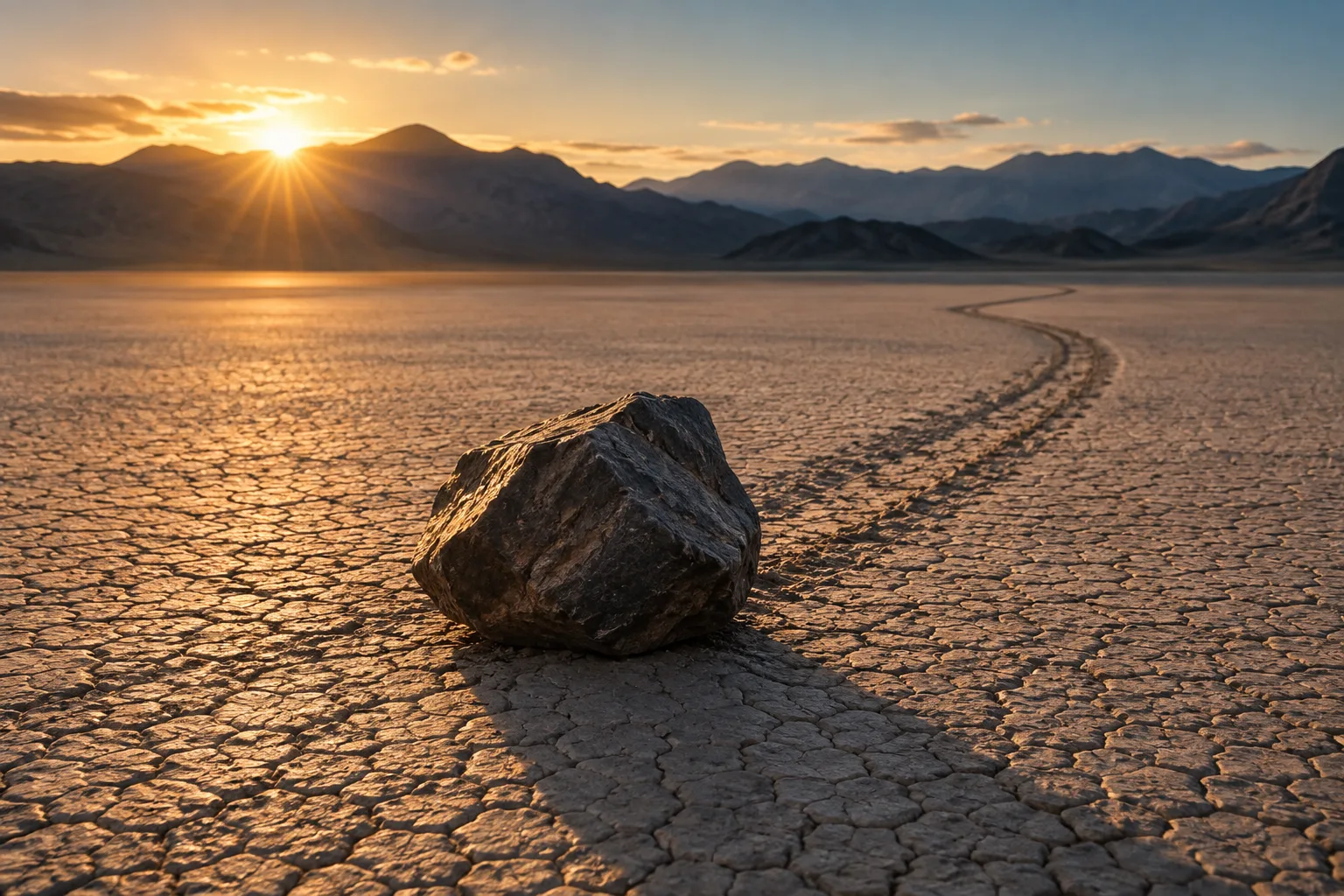
A landscape with evidence, but no witness
A rock at the end of a long trail is a wonderfully awkward object. It looks like the final frame of a film whose earlier scenes have gone missing. On the dry surface of Racetrack Playa in Death Valley, that impression comes from something real: stones have left tracks across the lakebed, sometimes in patterns that look coordinated. The National Park Service describes hundreds of rocks and trails that can extend for hundreds of meters. Some stones remain still for years.
The temptation is to start with a dramatic explanation. A hidden hand, perhaps, or a wind powerful enough to send a boulder skating. But a trail alone does not tell us what conditions existed when it formed. Dry ground in a photograph need not have been dry during the event. A still landscape can preserve the aftermath of a brief transformation.
That distinction makes this more than a strange travel photograph. It is a compact lesson in reading evidence: the thing we can see may be a record of a situation we cannot. Ask what would need to change around the rock, rather than assuming the rock did something extraordinary. The answer, as observations eventually showed, involved a very ordinary material behaving at just the right moment.
All 3 chapters
Sources & further reading
Checked . Explanation and commentary are original; factual claims draw on these primary sources.