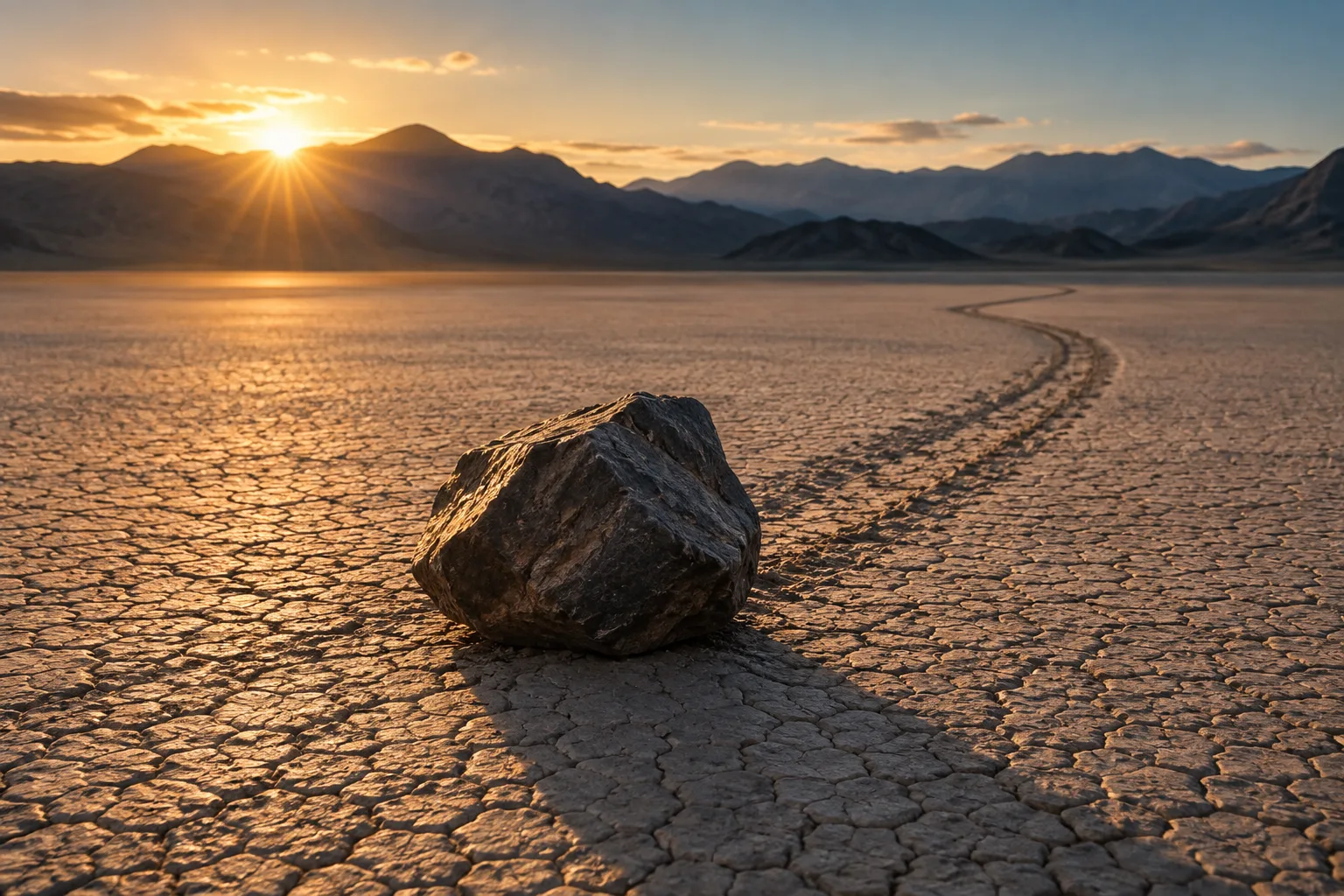
The ice was thinner than you might expect
In research published in 2014, Richard Norris and his colleagues described direct observations using instrumented rocks, photography and weather measurements. Their observed mechanism involved thin ice on shallow water. As the ice began to melt and break into floating panels, light winds moved those panels, which pushed rocks across the wet surface. The reported ice was only about three to six millimeters thick. This was not a scene of stones racing across bare, sun-baked ground.
The study reported slow motion, commonly a few meters per minute, and an event in which more than sixty rocks moved. A broad moving panel helps explain why separate stones could leave related tracks. The crucial observation was the interaction among water, ice, wind and rock, rather than any single ingredient acting alone.
For a useful mental picture, imagine a tray of shallow water with a delicate sheet on its surface. Now imagine the sheet breaking and drifting until an edge reaches an object. The analogy is only a way to organize the sequence, not an experiment that reproduces the playa. It helps separate the moving surface from the object it pushes. The remarkable result comes from a combination of ordinary processes, occurring together in a setting that usually looks entirely different.
All 3 chapters
Sources & further reading
Checked . Explanation and commentary are original; factual claims draw on these primary sources.