A move before opening
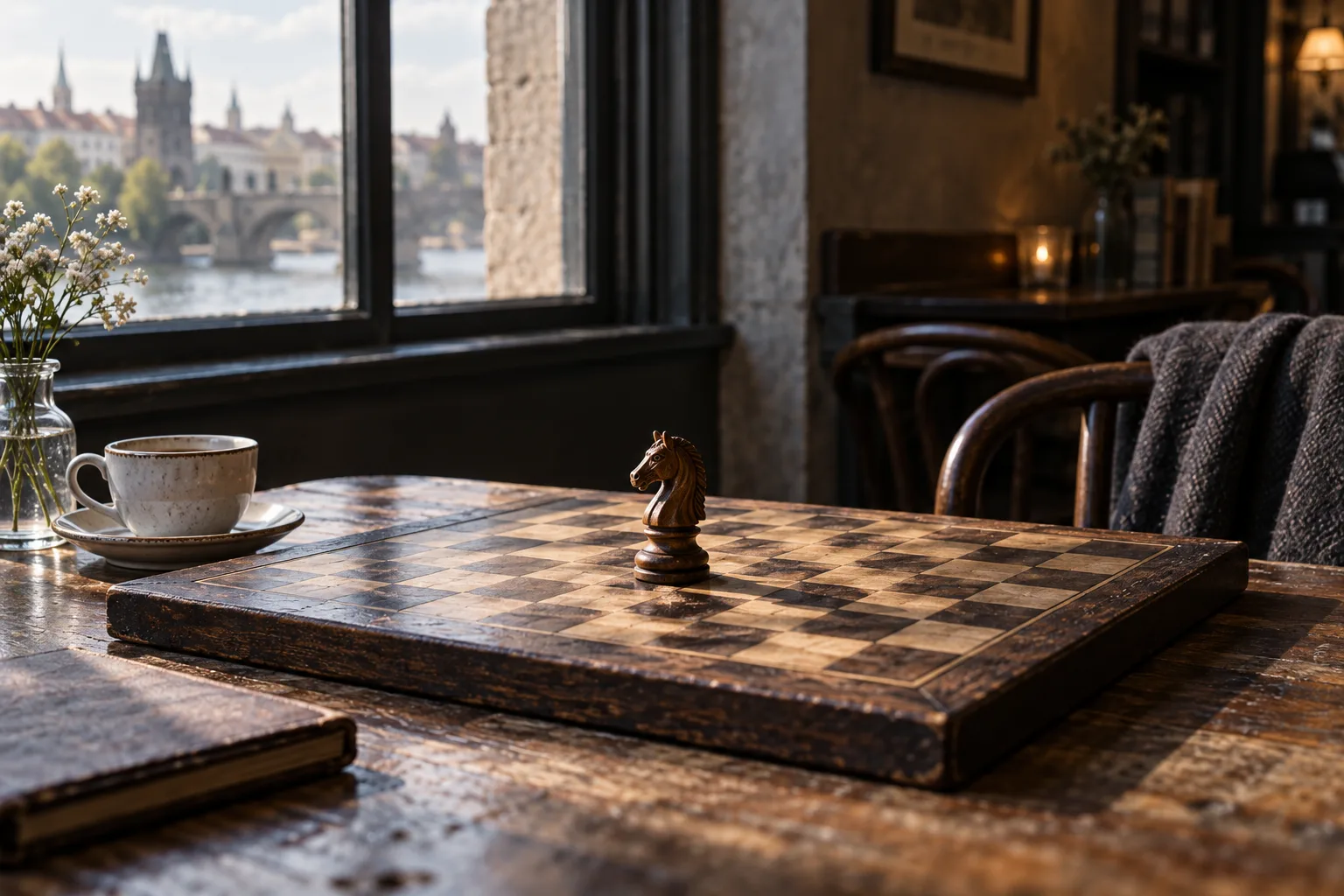
When Elian inherited the corner cafe, he kept his aunt’s chessboard on the window table. Most of the pieces were packed away, but one wooden knight remained. On Monday it stood near the center. On Tuesday it had moved two squares toward the window. By Friday, Elian had begun sketching its positions on the back of old receipts.
Only three people entered before him: the cleaner, the bread supplier, and his aunt’s friend Rosa, who watered the window plants. All three denied playing chess. Rosa added that his aunt had been terrible at it. Elian found this hard to reconcile with the worn board, whose pale squares were polished by years of use.
He tried treating the positions as a sequence of legal knight moves. The pattern failed immediately. He tried reading the squares as letters and numbers, but his aunt had never marked coordinates around the edge. Then he noticed that each new position lay beside a different shallow scratch. The knight was pointing to marks already there.
On Saturday he left a note beside the board: “I would like to understand.” The next morning the knight stayed where it was. Beside it sat a small envelope containing a strip of tracing paper, folded into quarters. Eight little circles were drawn on it, but there were no words. Whoever had started the puzzle seemed ready to provide another piece.
The board was a map
Elian unfolded the paper over the chessboard. The circles matched neither the corners nor the centers of its squares. They did, however, line up with the scratches if he turned the paper sideways. One circle was darker than the others. He lifted the board and examined its underside, expecting a compartment or a message. There was only his aunt’s name in pencil.
Rosa arrived while he was holding it up. This time she did not deny knowing about the knight. She said she had moved it, then looked embarrassed. His aunt had asked her to help Elian remember something, but Rosa had turned the request into a riddle because she thought it would make him curious. It had mostly made him suspicious of the bread supplier.
The tracing paper came from an old arrangement of tables. His aunt had used the chessboard to plan the cafe floor during a renovation, assigning one chair to each marked place. The dark circle was the window seat where Elian had done his schoolwork. He remembered the chair now: its short leg had made it rock whenever he reached for his drink.
Rosa explained that the knight was his aunt’s stand-in for him, because he was always moving in unexpected directions. The last marked position was outside the old seating arrangement. It pointed toward a narrow alcove that had been hidden behind a tall cupboard for as long as Elian could remember.
Room for a new table
They moved the cupboard together and found a shallow recess with a folded drawing pinned inside. It was not a treasure map. It was a plan for a small writing desk, narrow enough to fit the alcove without blocking the passage. His aunt had measured it carefully and written Elian’s name above the chair.
He had once told her he wanted to write stories, years before he began managing the cafe. She had listened without turning the idea into a family announcement. The drawing was her quiet way of making space for it. Rosa had promised to pass it on when the cafe changed hands, then worried that a plain envelope would disappear among invoices.
Elian thanked her for keeping the promise and asked her to retire the mysterious delivery method. Next time, he said, a conversation would be enough. They laughed, and he put the knight back in its box. The board had explained the clue, but it did not need to become a permanent shrine to the puzzle.
A week later, a carpenter installed the little desk. Elian used it for accounts at first, then for a paragraph written after closing. He left the cupboard where it had been moved, opening the alcove to the room. His aunt’s final gift was neither a hidden fortune nor a command to become someone else. It was a small, measured place where an unfinished ambition could begin again.