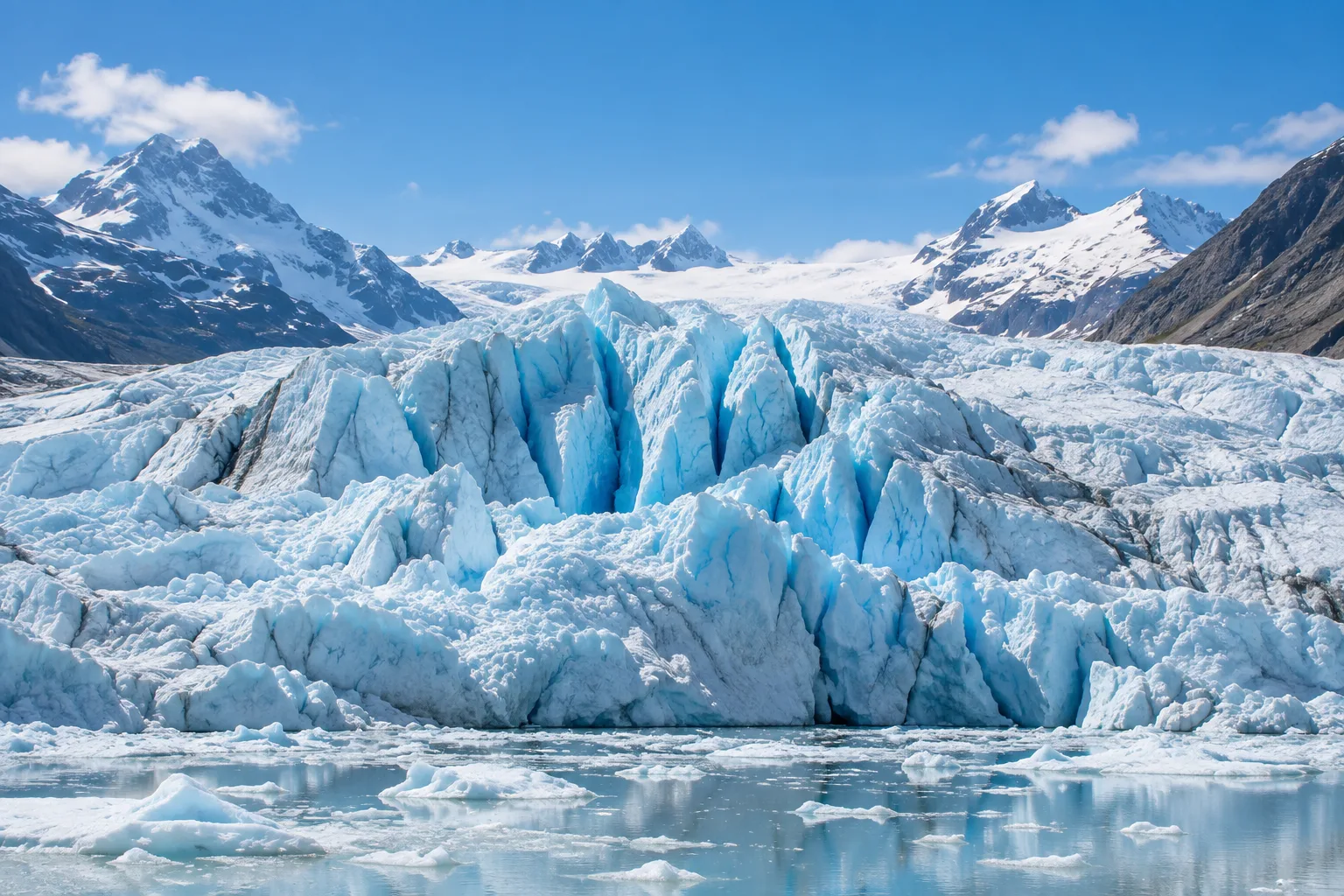
A frozen landscape with a moving interior
A glacier photograph seems to preserve stillness twice: once because the camera stops time, and again because ice looks rigid. Yet a glacier is a moving mass. The National Park Service explains that accumulated snow can survive successive summers, become denser, and eventually form ice that flows under its own weight. The interesting question is not whether ice can move, but what movement means inside something that remains largely solid.
The transition starts before there is an obvious blue wall or fractured tongue. Older snow becomes firn, an intermediate material between fresh snow and glacier ice. Additional layers and changes in the snow structure contribute to the transformation. A single winter storm therefore cannot tell the whole story. What remains after melting seasons matters alongside what falls during snowy ones.
This gives a useful way to read a mountain scene without pretending that a photograph is a measurement campaign. White snow, exposed ice, and neighboring bare rock can be clues to different parts of the system. Their appearance alone does not establish how much mass the glacier has gained or lost across a year.
The first adjustment is one of scale. A piece of ice held in a hand is not under the same conditions as ice buried within a large glacier. To understand the landscape, we need to look below its surface and consider the weight of the material above it. That is where the apparent stillness begins to unravel.
Movement has more than one route
NPS describes two broad contributors to glacier motion: deformation within the ice and movement at its base. At the scale of crystals, ice can change shape and rearrange. At the bed, a glacier may slide over rock or move with deforming sediment. These mechanisms explain why flowing ice need not be a liquid stream concealed under a frozen crust.
Water can influence the contact between ice and ground. Meltwater may reach the bed through openings in the glacier; melting can also occur near the base. NPS describes how water can aid sliding or weaken underlying sediment. That does not make every glacier identical. The bed, water conditions, and geometry all belong to the explanation of a particular glacier’s behavior.
The surface can record stresses generated by this movement. Crevasses are cracks in the ice, not gaps between separate glaciers that simply happened to collide. Their presence makes the solid surface look dramatically broken, but a crack is only one feature in a much larger system. It cannot, on its own, report the total amount of ice that has disappeared.
Consider two different questions an observer might ask: where did this marked piece of ice go, and where is the glacier’s edge now? They sound similar because both involve positions on a map. But they track different things. One follows material through the system; the other follows a boundary. Keeping those questions separate resolves one of the most confusing phrases in glacier descriptions.
Why retreat does not mean reverse
When a glacier retreats, its terminus moves back. That does not require all the ice behind it to reverse course. Glacier Bay National Park explicitly distinguishes the changing face from the continuing down-valley movement of ice. If losses near the margin outpace the arrival of ice there, the edge can withdraw even as material flows toward it.
An analogy helps, provided we do not mistake it for the physics of a glacier. Imagine a queue whose front keeps serving people while fewer people join at the back. The end of the queue can move toward the service desk even though everyone in it continues stepping forward. A boundary and its contents can move differently without contradiction.
Scientists also ask a broader accounting question: how much mass was added and how much was lost during a specified interval? USGS describes field measurements, elevation comparisons, and weather observations used to study glacier change. The position of one edge and the direction of one marker provide useful information, but neither alone is a complete glacier-wide balance sheet.
The landscape can retain evidence after ice leaves. Moraines are accumulations of glacier-related sediment; their locations and materials help tell a different part of the story from a current ice marker. The payoff is a more precise vocabulary for looking: flow describes movement, retreat describes a changing margin, and mass balance describes gains against losses. A glacier can be doing all three at once.
All 3 chapters
Sources & further reading
Checked . Explanation and commentary are original; factual claims draw on these primary sources.