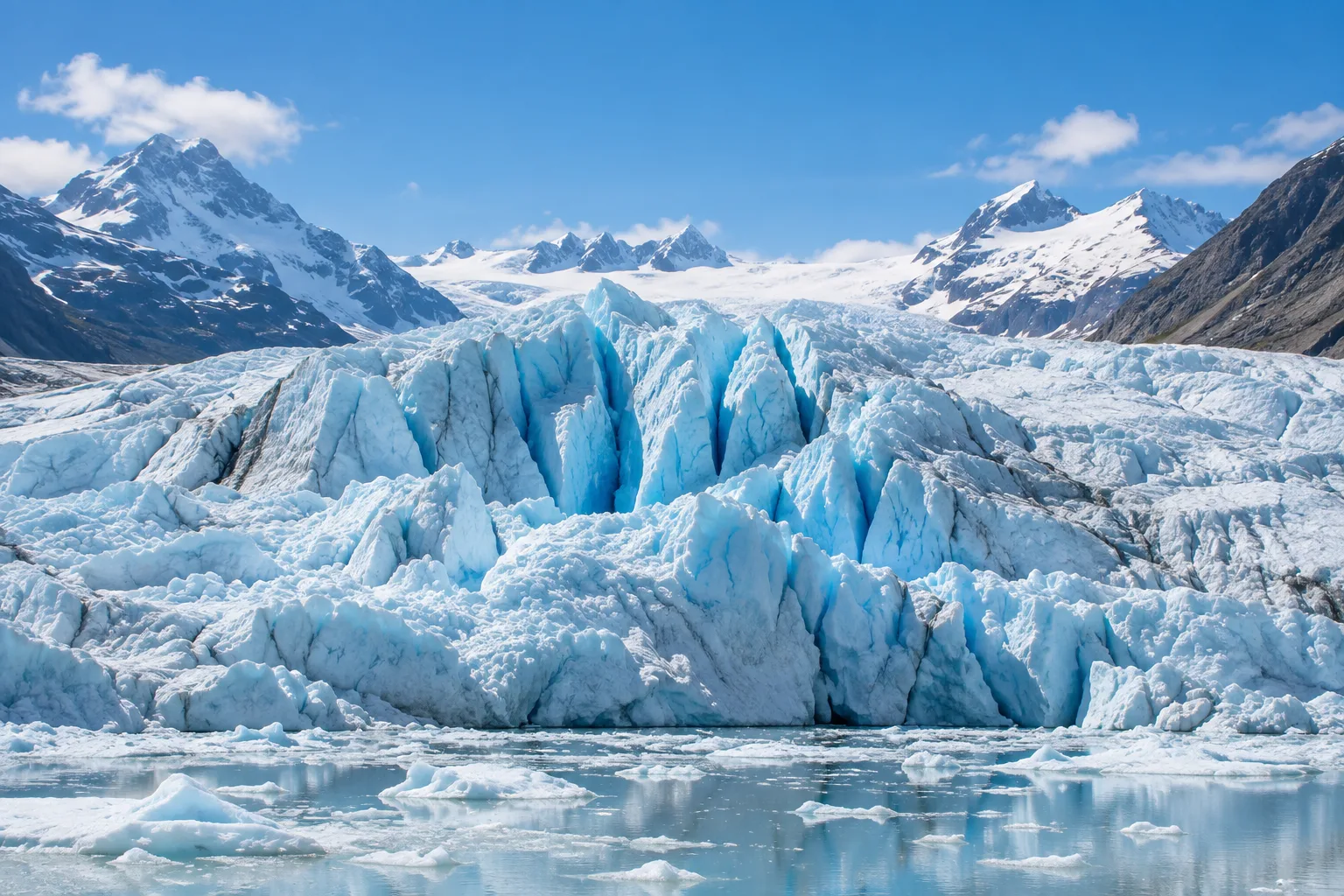
Why retreat does not mean reverse
When a glacier retreats, its terminus moves back. That does not require all the ice behind it to reverse course. Glacier Bay National Park explicitly distinguishes the changing face from the continuing down-valley movement of ice. If losses near the margin outpace the arrival of ice there, the edge can withdraw even as material flows toward it.
An analogy helps, provided we do not mistake it for the physics of a glacier. Imagine a queue whose front keeps serving people while fewer people join at the back. The end of the queue can move toward the service desk even though everyone in it continues stepping forward. A boundary and its contents can move differently without contradiction.
Scientists also ask a broader accounting question: how much mass was added and how much was lost during a specified interval? USGS describes field measurements, elevation comparisons, and weather observations used to study glacier change. The position of one edge and the direction of one marker provide useful information, but neither alone is a complete glacier-wide balance sheet.
The landscape can retain evidence after ice leaves. Moraines are accumulations of glacier-related sediment; their locations and materials help tell a different part of the story from a current ice marker. The payoff is a more precise vocabulary for looking: flow describes movement, retreat describes a changing margin, and mass balance describes gains against losses. A glacier can be doing all three at once.
All 3 chapters
Sources & further reading
Checked . Explanation and commentary are original; factual claims draw on these primary sources.