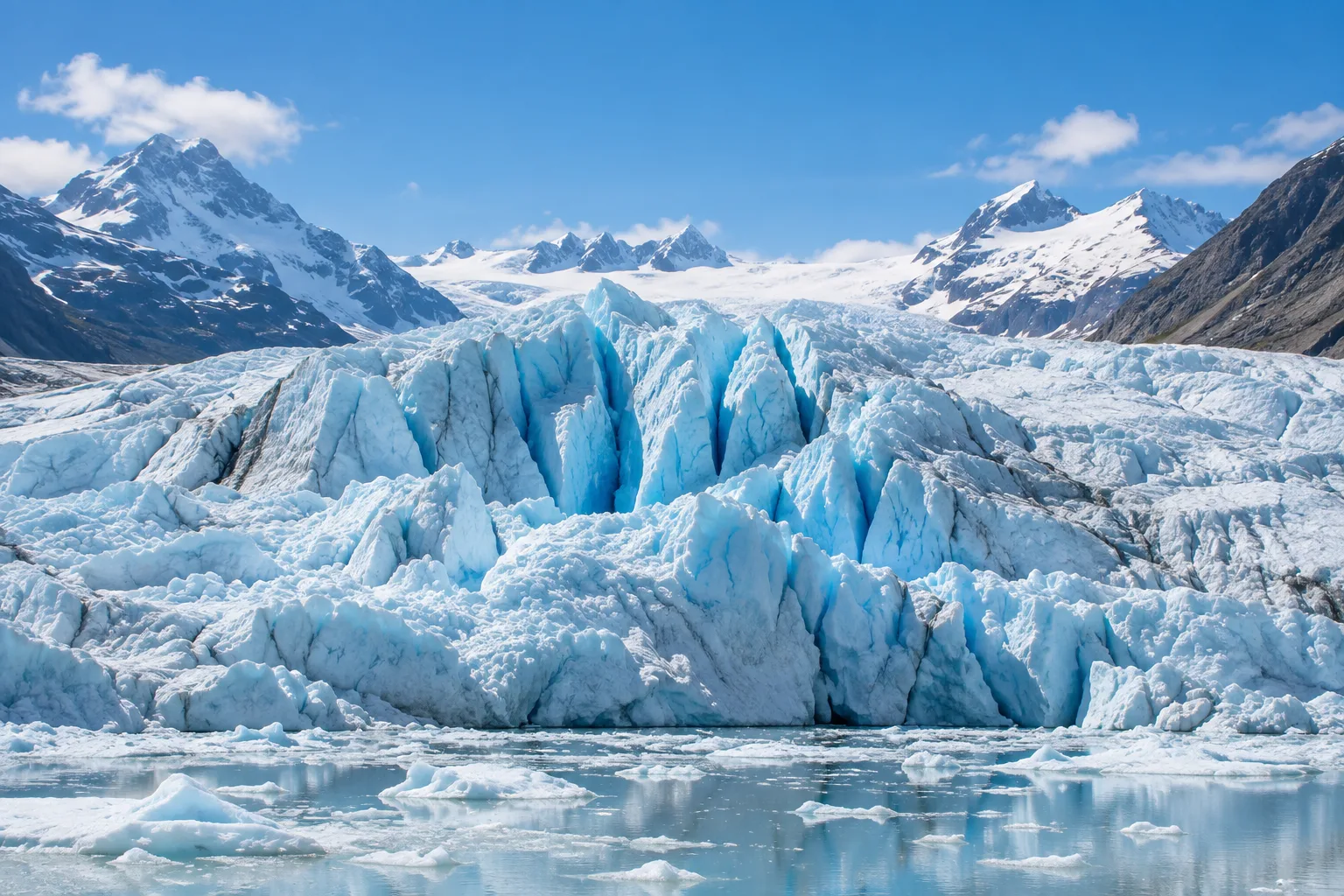
A frozen landscape with a moving interior
A glacier photograph seems to preserve stillness twice: once because the camera stops time, and again because ice looks rigid. Yet a glacier is a moving mass. The National Park Service explains that accumulated snow can survive successive summers, become denser, and eventually form ice that flows under its own weight. The interesting question is not whether ice can move, but what movement means inside something that remains largely solid.
The transition starts before there is an obvious blue wall or fractured tongue. Older snow becomes firn, an intermediate material between fresh snow and glacier ice. Additional layers and changes in the snow structure contribute to the transformation. A single winter storm therefore cannot tell the whole story. What remains after melting seasons matters alongside what falls during snowy ones.
This gives a useful way to read a mountain scene without pretending that a photograph is a measurement campaign. White snow, exposed ice, and neighboring bare rock can be clues to different parts of the system. Their appearance alone does not establish how much mass the glacier has gained or lost across a year.
The first adjustment is one of scale. A piece of ice held in a hand is not under the same conditions as ice buried within a large glacier. To understand the landscape, we need to look below its surface and consider the weight of the material above it. That is where the apparent stillness begins to unravel.
All 3 chapters
Sources & further reading
Checked . Explanation and commentary are original; factual claims draw on these primary sources.