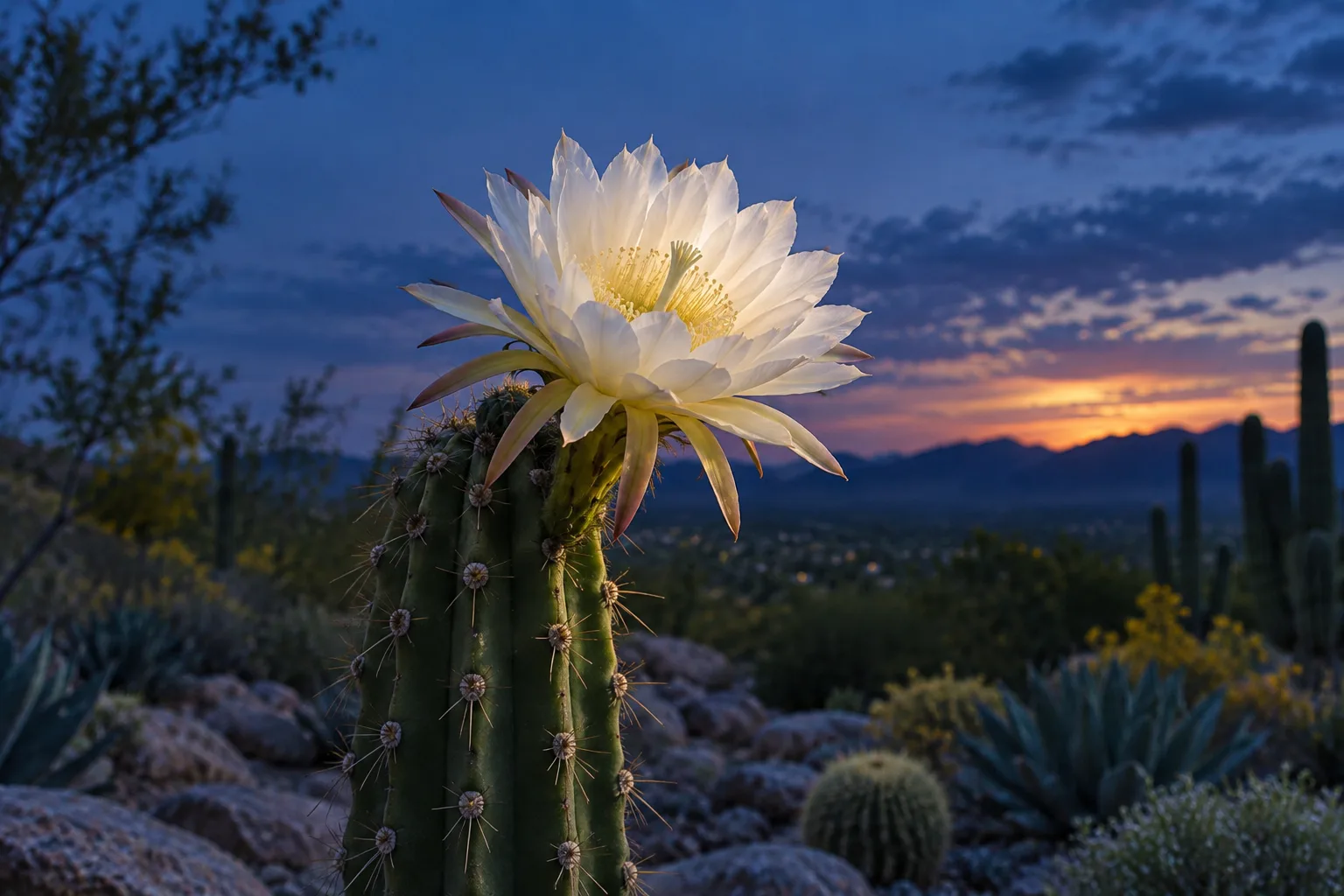
A bloom after closing time
If you imagine a garden only in daylight, you have already decided when its interesting activity happens. Try changing the scene: a pale flower against a darkening sky, with no bright sun to announce that it is open. The image is an invitation to ask a better question. Who might be visiting when the human observer has gone indoors? In the Sonoran Desert, bats can be part of the answer.
The National Park Service describes saguaro flowers opening at night and closing the following day. They receive visits from birds, insects, and bats. That short opening window helps explain why timing belongs in a plant's story. A flower is not just a permanent ornament. It offers an opportunity that different animals can encounter at different hours.
At Organ Pipe Cactus National Monument, the Park Service describes lesser long-nosed bats following the flowering season of columnar cacti northward. Their journey connects food availability across places. It is tempting to turn that into a picture of every garden waiting for the same visitor, but that would erase the geography and the species involved. This is a particular desert relationship. Its broader lesson is a question we can carry elsewhere: which visitors match the place, the season, and the hour? The answer begins with looking more closely, not with assuming that every winged shape has the same job.
The meal leaves a trace
In the Park Service's account, a nectar-feeding bat reaches into a cactus flower with its muzzle and tongue. Pollen gathers on its head. When it visits another flower, some of that material can travel with it. A meal and a plant's reproduction become connected through the animal's movement. The bat does not have to intend to help the flower for that transfer to matter.
Think of this as a sequence rather than a slogan about a helpful animal: arrival, contact, departure, another contact. Each step makes the relationship easier to picture. It also shows why a photograph of a bat near a flower would be only one moment in the process. The movement between flowers is central to the explanation. The Park Service describes long muzzles and tongues in nectar-feeding bats at Saguaro, features that help them reach their food.
Other bats connect with plants and animals in different ways. The Park Service lists insect consumption and seed dispersal among the benefits of bats, alongside pollination. Those roles are not interchangeable. Moving a seed is different from moving pollen, and catching an insect is different from either. Imagine replacing the word bat in a nature caption with a description of what the animal is doing. The caption would immediately become more informative. Diet and behavior tell us something that a dramatic silhouette alone cannot.
Keep the variety in the picture
The same care belongs in a discussion of bat senses. Echolocation involves outgoing sounds and returning echoes, according to the National Park Service. Many calls are above our hearing range, so researchers use specialized recording equipment. A quiet evening to a human listener can contain information that the right instrument reveals. Silence to our ears is not evidence that nothing is happening.
That does not make bats blind. The Park Service explicitly rejects that familiar misconception. Nor does one way of spending winter describe the entire group: some bats hibernate and others migrate. These distinctions are useful because they interrupt the habit of turning a whole group of animals into one character. A small vocabulary change, from bats always do something to some bats do it, can make a description much more accurate.
Return to the flower that opened this story. It is interesting without becoming a symbol for every bat or every garden. In the documented desert relationship, a flower offers food and a traveling animal can carry pollen onward. In another setting, a bat may be pursuing insects. The payoff is a richer picture of night, assembled from specific relationships rather than a single spooky image. If a shape passes overhead at dusk, you may not know its species or meal. You can still ask more useful questions about what evidence would tell you. Curiosity begins where the confident shortcut ends.
Sources & further reading
Checked . Explanation and commentary are original; factual claims draw on these primary sources.