A station without a name
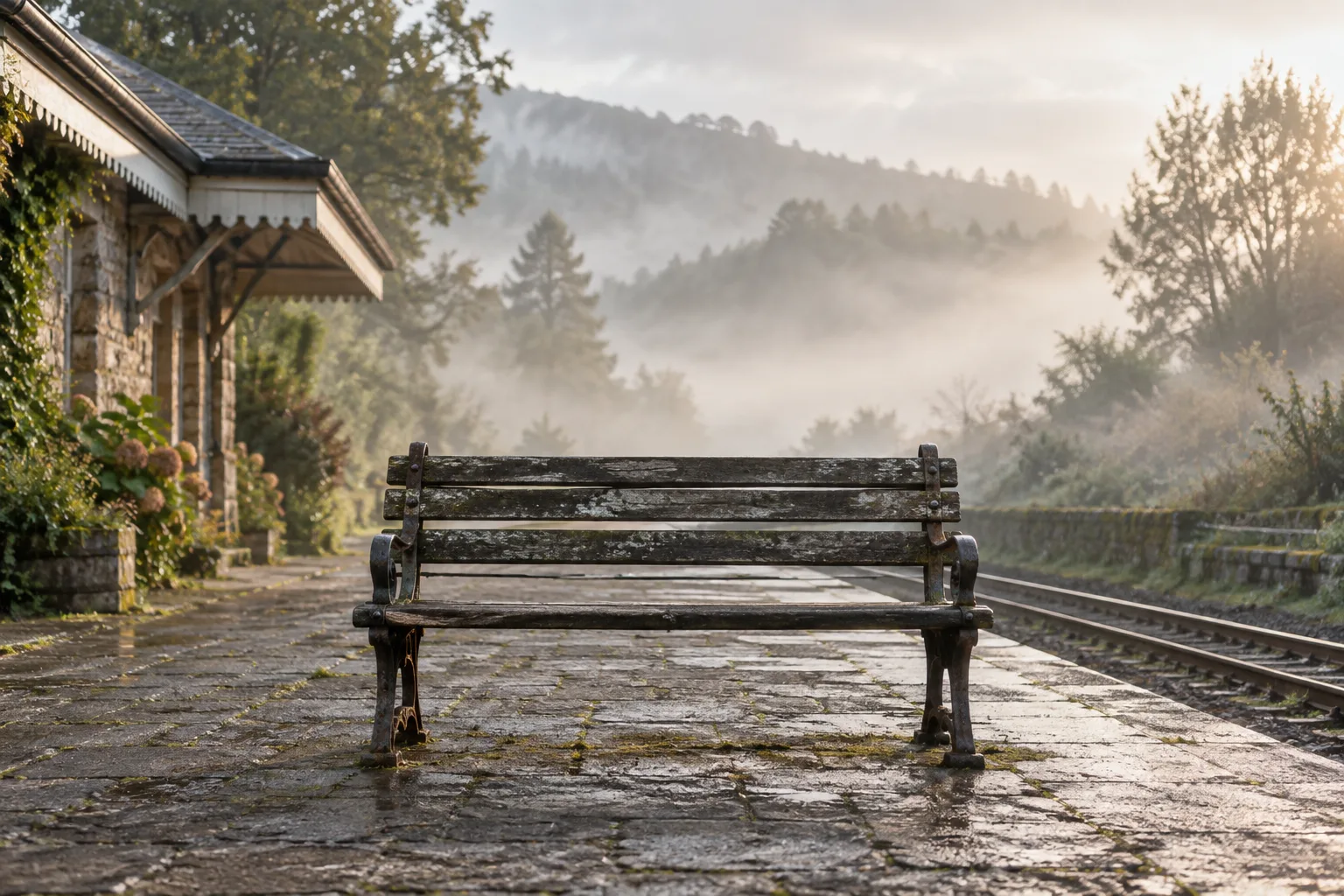
The photograph arrived inside a box of donated railway timetables. It showed a platform, a bench, and the lower corner of a station canopy. Someone had carefully cut away the sign above the bench. On the back, in pencil, were the words last morning before everything changed. Nora, who was assembling the village hall's history display, could not resist a place with its name missing.
She spread old maps across the table and checked the stations along the closed branch line. None matched. One had the wrong roof supports; another had never possessed a covered platform. The bench was the most distinctive feature: one end curved upward, while the other had a straight replacement arm. Nora pinned a copy beside the hall door and invited suggestions.
By lunchtime, five people had confidently named five different towns. An elderly visitor said the picture looked like the station where she had met her husband, then admitted that every station in her memory looked a little like that one. Nora began to suspect that the photograph was collecting stories more effectively than it was yielding an answer.
At closing time, the hall's caretaker, Ben, stopped beneath the copy. He did not look at the roof or the missing sign. He pointed at the straight bench arm. His father had repaired something just like it, he said, using a piece of wood from their kitchen door. But his father had never worked for the railway.
The wrong kind of platform
Ben brought in a smaller photograph the next morning. It showed his father standing beside the same repaired bench, surrounded by people holding paintbrushes. Behind them was a brick wall with three tall windows. Nora recognized those windows immediately. They belonged to the village hall, though the room in front of them had since been divided into storage cupboards.
The supposed station platform had been a stage set. Once Nora considered that possibility, the clues changed their meaning. The shadow beneath the platform looked too shallow for a track bed. The roof support stopped at an awkward edge that the photographer had mostly avoided. Even the gravel beside the bench could have been scattered over boards.
They searched the hall's old booking ledger and found a week reserved for a play called The Last Train Home. A faded program listed Ben's father under scenery and a woman named Ruth Calder as stage manager. Ruth still lived above the bakery. When Nora showed her the image, she recognized the set before Nora had finished asking.
Ruth said the photograph had been taken the morning after the final performance, before the scenery came down. The cropped sign had carried a fictional station name. The person who trimmed the print wanted it to look like a real place, a small joke for a cast album. But Ruth grew quiet when she read the pencil note. The words referred to something beyond the end of the play.
What changed that morning
The production had been Ruth's last project before she left the village to train as a stage designer. She had spent months saying the move was only an idea. On the morning they dismantled the set, the director handed her the photograph and told her to stop treating her own departure as a rehearsal. She wrote the note on the back while waiting for the bus.
Years later, the photograph had returned with other papers she donated during a move. She had forgotten which box held it. The place in the image was invented, but the moment was not: a room full of people had helped her make something believable, then encouraged her to try doing it somewhere larger. Nora finally understood why the ordinary scenery had been photographed so tenderly.
Ruth joined Nora and Ben at the hall that afternoon. Behind stacked folding tables they found the bench, still carrying its mismatched arm. Ben recognized the wood's old hinge marks. They cleaned it and moved it into the entrance, where visitors could sit while reading the display. The photograph went above it, with the fictional station name restored in the caption.
Nora changed the exhibition heading from Lost Railway Places to Places We Made Together. There was still room for the real timetables and maps. Beside them, the stage set offered a different kind of local history: a place that had never appeared on a railway map, yet had been a genuine point of departure. This time, no one had to guess where it was.