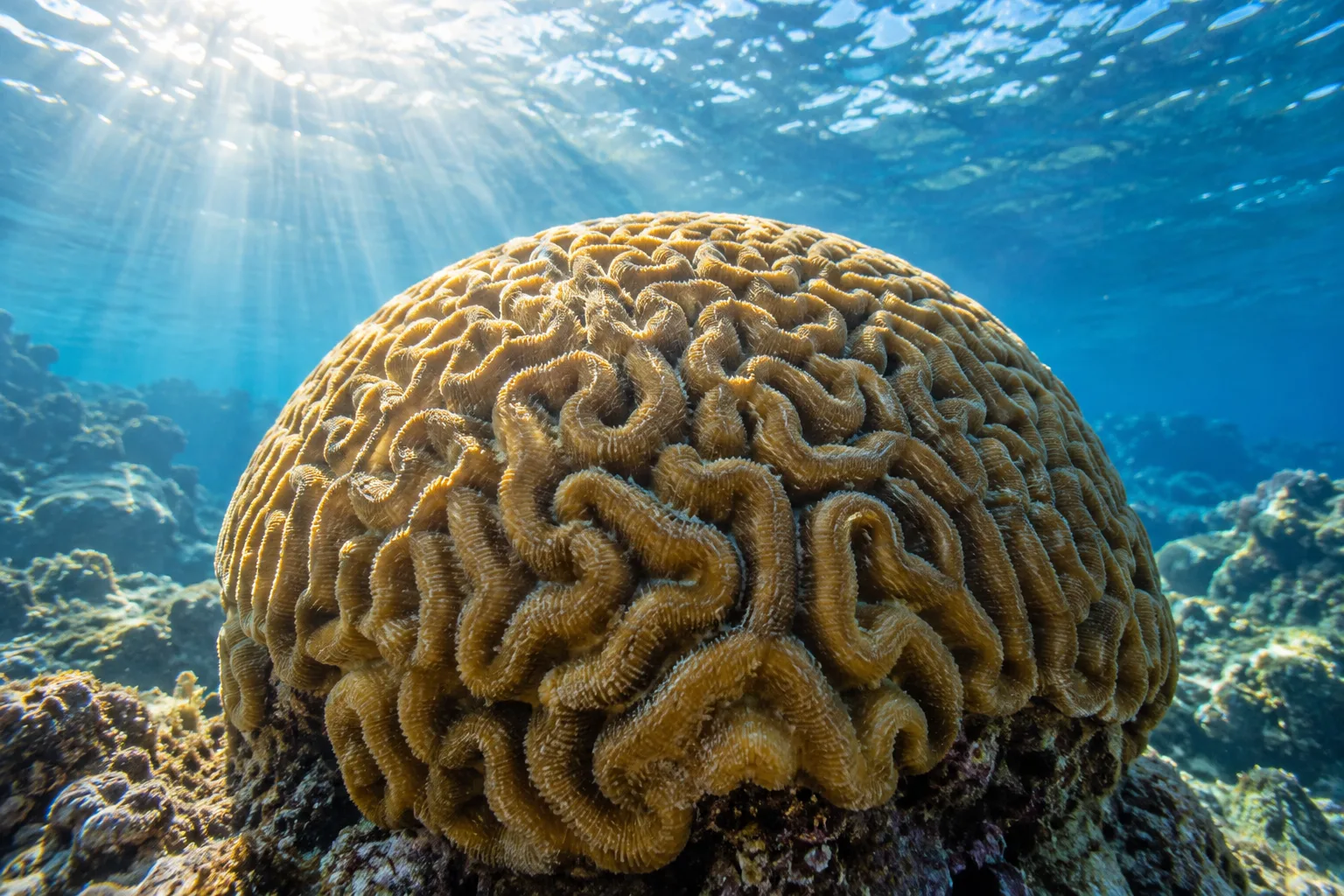
The animal inside the architecture
At first glance, a reef seems to invite the vocabulary of a garden. There are branching forms, rounded mounds, and crowded surfaces that appear to grow straight out of the seabed. But the familiar comparison conceals an important surprise: a coral polyp is an animal. The landscape becomes more interesting when you stop treating every stationary shape as a kind of underwater plant.
NOAA describes polyps as small, soft-bodied animals with tentacles used to capture food. In stony corals, the animal secretes a hard calcium carbonate skeleton. Living tissue and the structure beneath it are related, but they are not the same thing. Think of the distinction as the difference between a builder and the material being added to a building, while remembering that the builder remains part of the scene.
A reef's substantial framework can accumulate from these much smaller contributions. That change of scale is the first useful adjustment to make when looking at one: the broad underwater structure and the individual polyp answer different questions. One describes the landscape; the other helps explain how portions of that landscape are made.
It also changes the question you bring to a photograph. Instead of asking only what shape the coral resembles, ask which part is living tissue and what processes support it. The next part of the story takes place at a smaller scale still, within a partnership that helps many reef-building corals obtain energy.
A partnership that makes light matter
Many reef-building corals contain microscopic algae within their tissues. NOAA calls this a mutualistic relationship because both partners benefit. The coral provides a protected setting and resources, while the algae use sunlight in photosynthesis and share products of that process. A coral is still an animal; hosting a photosynthetic partner does not turn it into a plant.
This helps explain why light conditions matter so much for these reefs. The connection runs from sunlight through the algae to the host, rather than from sunlight directly into a stone skeleton. Clear water can allow that light to reach the partnership. It is a good example of how an apparently simple feature of a habitat can matter through a chain of relationships.
That chain also makes a familiar photograph harder to interpret than it first appears. A beautiful bright scene is not a complete assessment of reef condition. NOAA Fisheries describes additional pressures on shallow reefs, including sediment and pollutants carried from land, as well as physical damage from activities such as anchoring. Light is one part of a larger setting.
The useful lesson is to keep several scales in view at once. An individual animal, its microscopic partners, the hard structure, and the surrounding habitat are connected. None can stand in for all the others. With those distinctions established, a change in coral color becomes more than a visual surprise: it becomes a clue that needs careful interpretation.
What a white coral does—and does not—tell you
When coral loses many of its symbiotic algae under stress, it may become pale or white. The familiar name is bleaching. NOAA emphasizes a distinction that is easy to miss in dramatic images: a bleached coral is not necessarily dead. It may survive and recover, although sustained stress can lead to death. The visible change is serious without being an automatic verdict.
Unusually warm water is a major bleaching trigger, but temperature stress can also involve unusually cold conditions. Other changes in the environment can contribute as well. A photograph cannot, by itself, establish every cause or predict the outcome for the animal shown. That is a reason to seek context, not a reason to dismiss the change.
Ocean acidification raises a different issue. NOAA explains that changing seawater chemistry can reduce the availability of carbonate ions used in calcium carbonate structures. Bleaching concerns the loss of a living partnership; acidification can make skeleton building and maintenance more difficult. These pressures can affect the same environment, but the terms describe different processes.
Return now to the first impression of an underwater garden. You can see why it was useful and why it was incomplete. The reef includes animals that build, partners that photosynthesize, and chemistry that influences construction. Understanding those connections makes the landscape richer than its colors alone, while leaving room for the observations and measurements needed to judge any particular reef.
All 3 chapters
Sources & further reading
Checked . Explanation and commentary are original; factual claims draw on these primary sources.