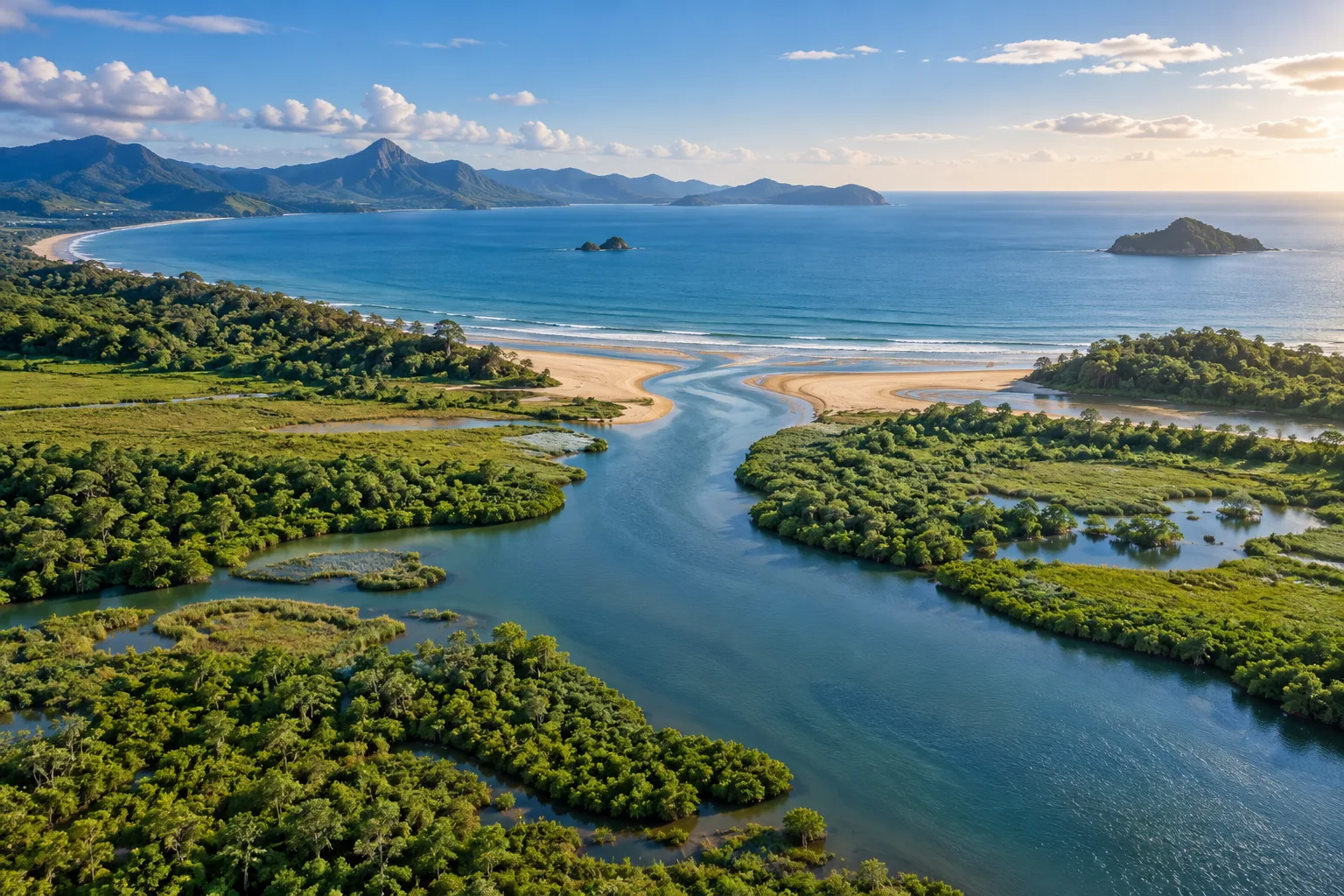
A boundary that will not hold still
On a map, a river reaches the sea at a crisp line. In the water, the meeting can be far less tidy. Many coastal estuaries mix river water with seawater, producing brackish conditions. Tides, river flow, and the shape of the basin affect that mixture. A label on the map remains in place while the conditions underneath it keep changing.
NOAA’s estuary tutorial describes salinity as a variable property, not a single number attached permanently to every estuary. Where and when a measurement is made matters. A sample after heavy rain may tell a different story from one during a dry spell, and a surface measurement may differ from water farther below.
The familiar coastal picture also has an exception worth keeping. NOAA recognizes freshwater estuaries associated with large lake systems such as the Great Lakes. That does not erase the usefulness of the river-meets-sea explanation. It reminds us that a useful introductory description should not be turned into an absolute rule that excludes real places.
For the coastal systems considered here, imagine a meeting zone with moving participants. Freshwater input changes, the tide exchanges water, and local geography shapes the pathways. The question is not simply whether the water is salty. It is how the mixture varies through the place, through the water column, and through time. That changing setting is also where many organisms make their lives.
Shelter is only part of the story
Estuaries support animals that use them in different ways. Some remain for much of their lives, while others arrive for a particular stage or season. NOAA describes nursery areas for fish and shellfish, feeding and nesting habitat, and stopovers for migrating birds. The word nursery captures an important function without meaning that only young animals belong there.
Sheltered channels and wetlands are therefore connected to life beyond their immediate edges. An animal can depend on one habitat early in life and another later. Protecting only the place where an adult is eventually seen may miss an earlier part of the same life cycle. This is a way of thinking about connections, rather than a claim that every species follows one identical route.
Water also brings material from the surrounding watershed: the land that drains toward the estuary. Nutrients can support growth, but runoff may carry pollutants as well. NOAA explains how marsh grasses and surrounding soils can retain sediments and filter some substances. That service is valuable precisely because the estuary receives influences from a much larger area.
A filter is not a permission slip for unlimited waste. Material retained in a habitat does not make the habitat immune to contamination. The same system can be productive and under pressure. Looking upstream becomes part of understanding the shoreline, because an apparently distant activity can be connected to the water moving through a marsh.
What one sample cannot settle
Suppose two visitors collect water on different days and report different salinities. Neither result must be wrong. NOAA’s monitoring guidance identifies location, tides, and freshwater inflow as influences on estuary salinity. Before choosing a winner, ask whether the samples came from comparable places, depths, and tidal conditions.
Mixing adds another complication. NOAA classifies estuaries partly by their circulation, distinguishing systems with different degrees of layering and mixing. Water does not necessarily become uniform the moment a river reaches the sea. A surface sample can be accurate for its collection point while failing to describe what lies underneath it.
A useful monitoring program therefore records context as well as numbers. Repeated observations can reveal patterns that a single visit cannot establish. If rainfall is the question, matching locations and depths while recording tidal stage makes the comparison more informative. This is an explanation of sound comparison, not a claim that one simple sampling exercise replaces a full scientific assessment.
The payoff is a different way to see the estuary. Its variability is not background noise that prevents understanding; it is part of what needs to be understood. Habitat, circulation, and the watershed fit together. The quiet water beside a marsh may be carrying the consequences of weather inland, exchanging material with the sea, and supporting an animal’s next life stage—all within the same afternoon.
All 3 chapters
Sources & further reading
Checked . Explanation and commentary are original; factual claims draw on these primary sources.