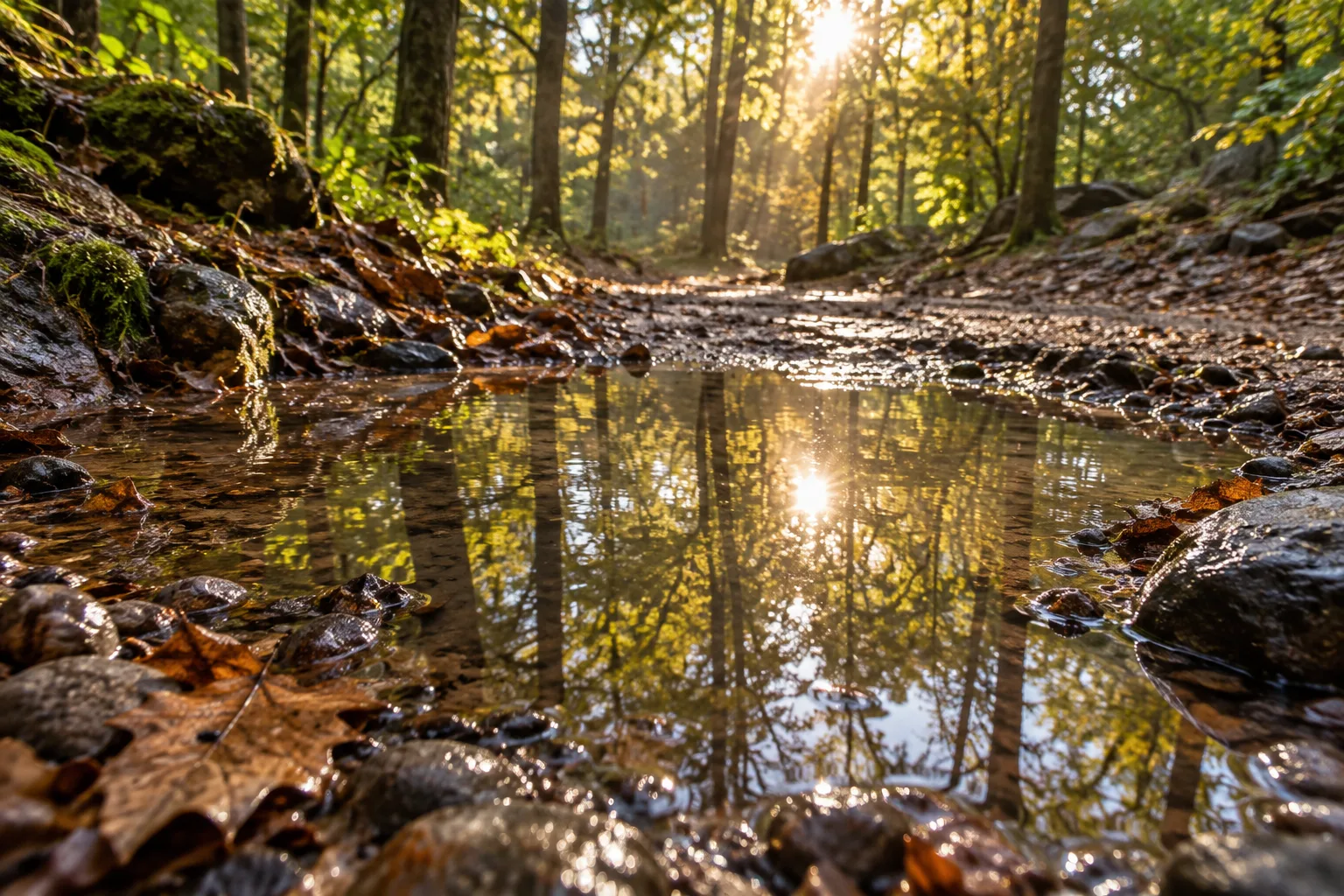
An empty patch is only the beginning
Imagine returning to a path after rain and finding a dry patch where a puddle had been. The everyday explanation is that the water disappeared. As an observation, that is understandable: the visible pool is gone. As an account of what happened, however, it leaves nearly every interesting question open. The water may have taken several routes rather than one.
Evaporation is one possibility. The US Geological Survey describes it as the change from liquid water to water vapor. It does not require a puddle to boil. Water can leave an exposed surface under ordinary conditions, becoming part of the atmosphere even though you no longer see it as a pool. The lack of a rising plume does not rule out that route.
Condensation works in the opposite direction, turning vapor into liquid. Droplets on the outside of a cold glass offer a familiar example: the glass need not be leaking. Water already present in the surrounding air can collect on its cold surface. That small observation helps separate a change of location from a change of state.
These examples are illustrations of processes, not a measurement of the particular puddle imagined here. To find out how much water evaporated, you would need more information than a before-and-after glance. The ground creates another possible exit, and understanding that exit requires following the water below the part of the landscape you can easily see.
The ground is not a sealed floor
Water entering the ground through its surface is infiltrating. According to USGS, some of it stays relatively near the surface, while some can move deeper and contribute to groundwater recharge. How much follows either route depends on conditions. A patch of soil is therefore not merely a flat boundary where the story of rainfall stops.
Groundwater is often easier to imagine incorrectly than correctly. A drawing of an enormous underground lake may feel intuitive, but USGS explains that water commonly occupies pores between particles and fractures in rock. In the saturated zone, those spaces are filled with water. Above the water table, the ground can still contain moisture without all its spaces being filled.
This distinction matters when you picture the vanished puddle. Water entering the soil does not instantly join a single giant cavern, and every damp patch is not automatically the water table. There are different places to store water and different pathways through the material. What looks solid from above can still have room for water between its components.
Plants add a further connection. They can take up water through roots, move it through their tissues, and release water vapor from leaves through transpiration. The route from ground to air can therefore pass through something living. A dry-looking path beside a leafy plant belongs to a connected system, even when none of that movement is obvious to someone walking past.
The circle is really a network
Some rainwater runs across the surface instead of entering the ground. Surface runoff can move toward streams, while groundwater can also discharge into streambeds and banks. USGS describes this groundwater contribution as an important source of sustained flow. A stream continuing after the rain stops is therefore not evidence that water has somehow stopped following the rules.
This is where a simple water-cycle circle can become limiting. It is useful for introducing familiar process names, but it can suggest a single orderly queue: every drop taking every step in the same sequence. USGS instead describes stores of water and flows between them. Different routes can operate at the same time, and water can remain in storage before moving again.
For the imagined puddle, the satisfying answer is deliberately plural. Evaporation could have transferred water to the air; infiltration could have moved it into the ground; drainage could have carried some away across the surface. The empty patch alone cannot tell you the share assigned to each route. A good explanation distinguishes possible mechanisms from quantities that were actually measured.
The next time a puddle fades, try looking beyond its outline. Notice the slope, the surface, the nearby vegetation, and where water could travel. Those observations will not provide a complete water budget, but they turn disappearance into a set of testable questions. The water's story continues after the small visible pool has gone.
All 3 chapters
Sources & further reading
Checked . Explanation and commentary are original; factual claims draw on these primary sources.