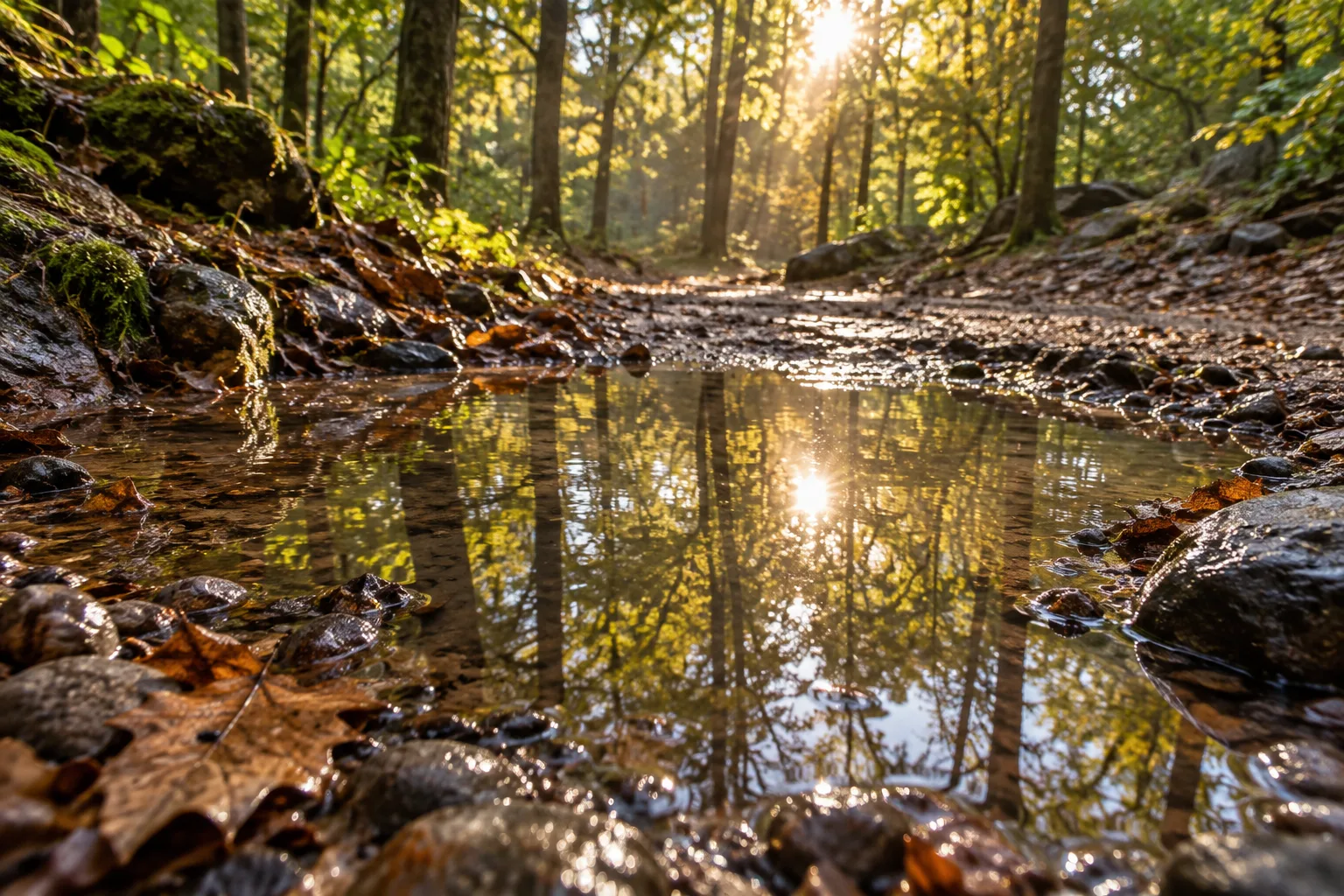
The ground is not a sealed floor
Water entering the ground through its surface is infiltrating. According to USGS, some of it stays relatively near the surface, while some can move deeper and contribute to groundwater recharge. How much follows either route depends on conditions. A patch of soil is therefore not merely a flat boundary where the story of rainfall stops.
Groundwater is often easier to imagine incorrectly than correctly. A drawing of an enormous underground lake may feel intuitive, but USGS explains that water commonly occupies pores between particles and fractures in rock. In the saturated zone, those spaces are filled with water. Above the water table, the ground can still contain moisture without all its spaces being filled.
This distinction matters when you picture the vanished puddle. Water entering the soil does not instantly join a single giant cavern, and every damp patch is not automatically the water table. There are different places to store water and different pathways through the material. What looks solid from above can still have room for water between its components.
Plants add a further connection. They can take up water through roots, move it through their tissues, and release water vapor from leaves through transpiration. The route from ground to air can therefore pass through something living. A dry-looking path beside a leafy plant belongs to a connected system, even when none of that movement is obvious to someone walking past.
All 3 chapters
Sources & further reading
Checked . Explanation and commentary are original; factual claims draw on these primary sources.