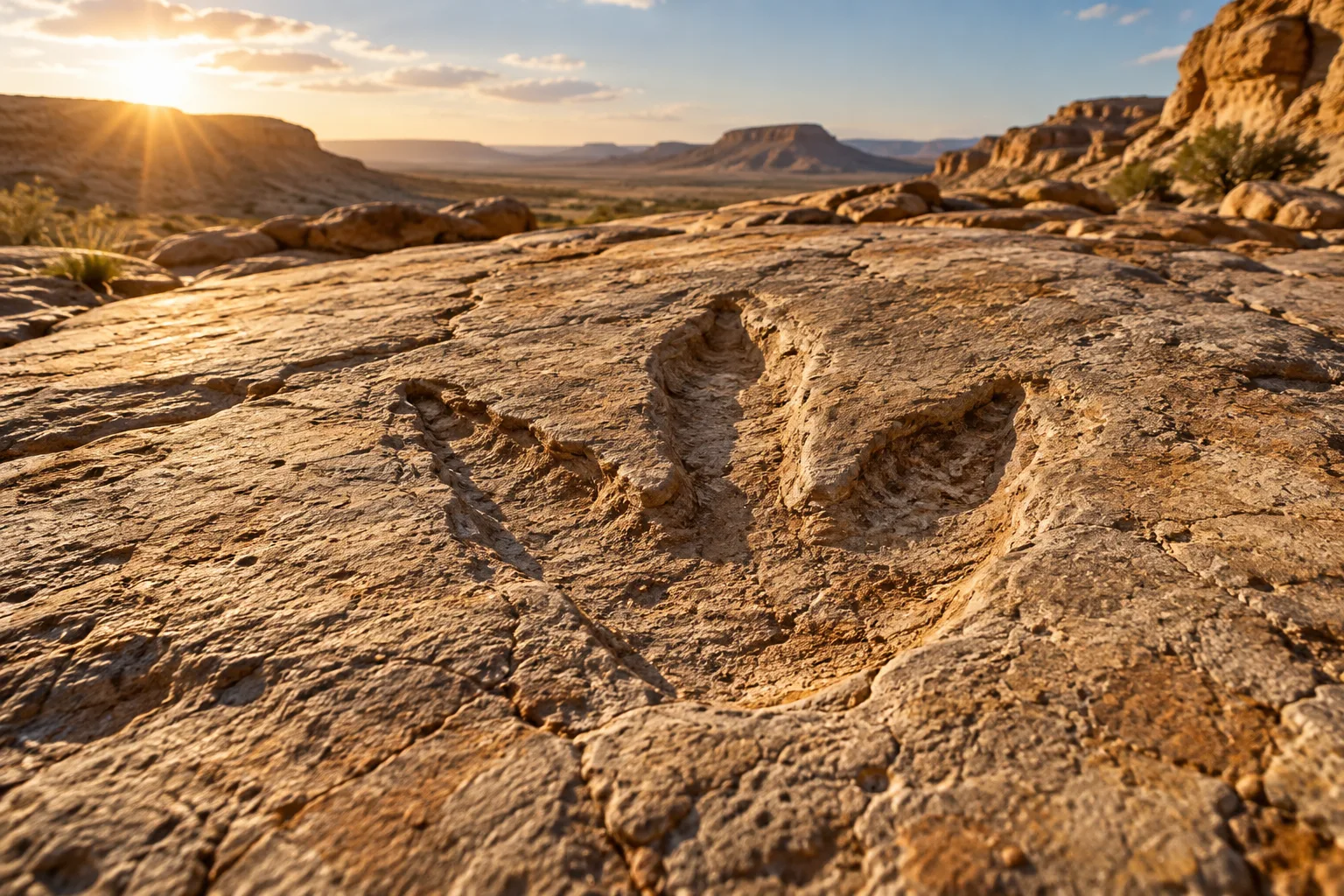
An animal can leave the scene and still leave evidence
Imagine two museum labels beside one another. The first identifies a tooth; the second identifies a footprint preserved in rock. Both belong in a fossil display, but they answer different kinds of questions. The tooth is part of an animal. The footprint records something an animal did. That distinction opens a much larger view of what the fossil record can contain.
The National Park Service groups evidence into body fossils and trace fossils. Bones, shells, and wood are familiar body remains. Tracks, burrows, and other traces preserve activity. A creature can make a footprint while alive and continue on its way. Finding the preserved impression does not require finding its skeleton beside it, or assuming that it died immediately after making the mark.
NPS explains that traces can provide clues about behavior and the environment in which an activity occurred. They are usually studied in the material where the activity took place, which makes their setting especially informative. A track is more than an attractive outline: its relationship to the surrounding surface is part of the evidence.
It is tempting to jump directly from a striking shape to an elaborate scene. A more useful first step is smaller: identify what is actually preserved. The tooth and the footprint can complement one another without telling the same story. Before deciding what either one means, however, there is another distinction to make between an original object and the ways its shape can survive.
The shape can outlast the original material
A shell-shaped fossil need not consist of the shell material an animal originally produced. NPS describes several routes by which form and material can become separated. In permineralization, minerals enter and fill natural pores. In replacement, new mineral material takes the place of original hard parts that have dissolved. Those processes can preserve useful detail while changing what the specimen is made of.
A mold and a cast offer a different pair of possibilities. An external mold preserves an impression of an object's outer surface. If material fills a natural mold, it can produce a cast. The distinction is easier to picture with a hollow shape and its solid counterpart than with the assumption that every fossil is simply an unchanged object buried in stone.
These terms describe preservation, not a ranking of scientific value. A cast is not automatically uninformative because the original shell is absent. Nor does mineral replacement mean that the preserved shape has nothing to say. The question is which details survived, how they survived, and what interpretation those details can support.
This also explains why a resemblance alone is a starting point rather than a conclusion. NPS notes that mineral patterns and ripple marks can look interesting without being fossils. Evidence of life must be distinguished from shapes produced by physical processes. The useful habit is to ask two questions separately: what made the original feature, and what happened to it afterward?
The gaps are part of the story
The path from a living organism to a fossil is not a neutral recording process. Hard parts such as teeth and shells generally withstand decay and damage better than delicate tissues. NPS describes soft-part preservation as comparatively rare and dependent on unusual circumstances. A collection rich in hard remains therefore cannot be treated as a complete inventory of everything that once lived.
Taphonomy is the study of what happens to remains between death and fossil preservation. Water can move them, scavengers can disturb them, and exposed material can break apart. Burial can protect some remains, while later physical and chemical changes can alter them further. A specimen's condition may tell a story about that journey as well as about the original organism.
That gives an incomplete fossil a different kind of interest. Missing pieces are not necessarily evidence that an animal lacked those parts in life. Scattered bones are not automatically a perfect map of where an animal stood. Those are interpretive questions that require the surrounding evidence and an understanding of preservation, rather than a dramatic explanation based on one fragment.
Return to the tooth and footprint in the imagined display. One offers a durable piece of anatomy; the other records an action at a surface. Together they illustrate why paleontology can work with much more than complete skeletons. The most satisfying conclusion is not that a fossil tells us everything, but that different kinds of evidence let us ask different, carefully bounded questions about the past.
All 3 chapters
Sources & further reading
Checked . Explanation and commentary are original; factual claims draw on these primary sources.