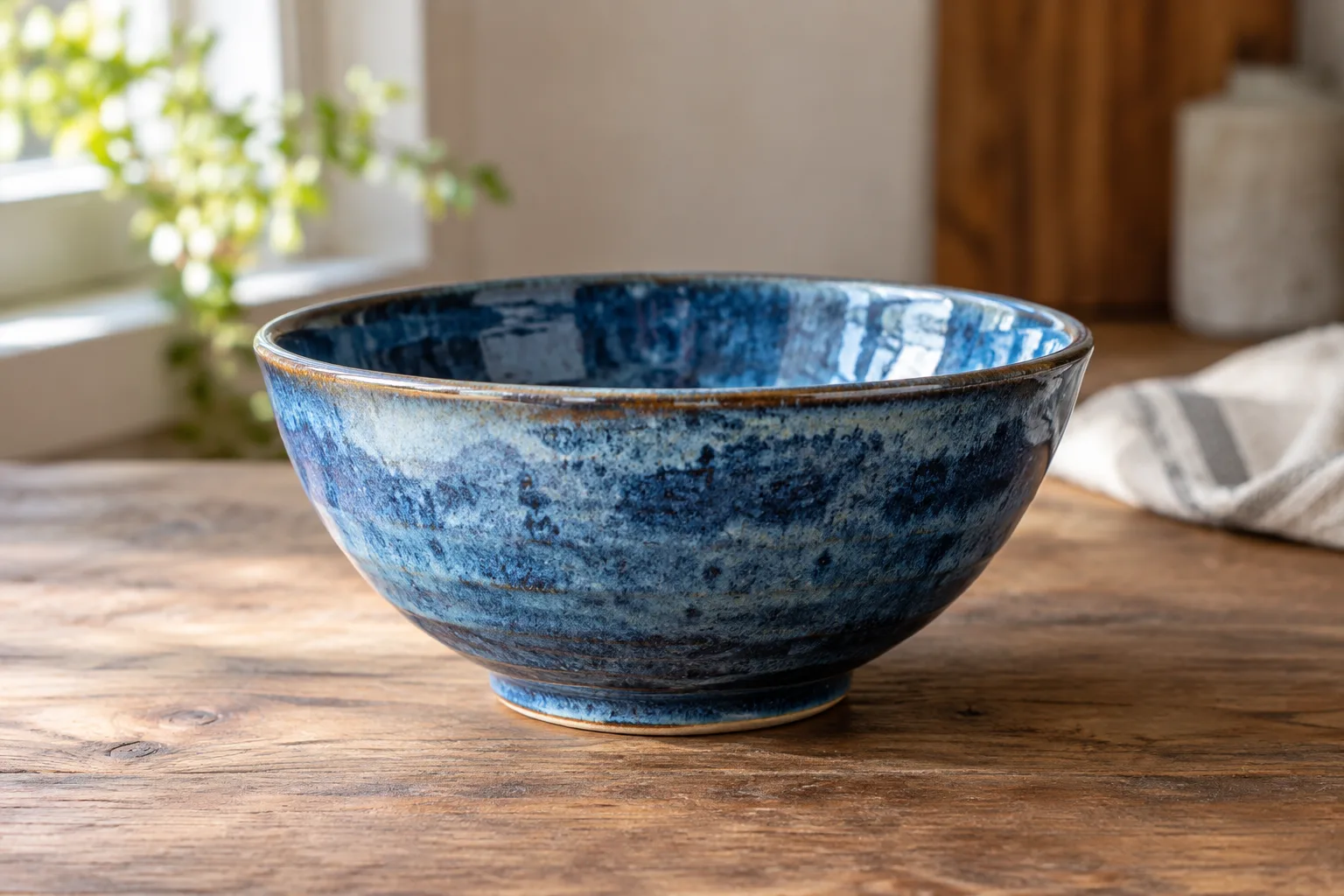
Two bowls, two different futures
Imagine two plain bowls sitting side by side on a workbench. Both hold their shape. Both might look finished to someone passing the doorway. Yet one could be returned to a workable clay mixture, while the other has crossed a material boundary. Their appearance alone does not tell the whole story of how they reached the table.
The Victoria and Albert Museum explains that unfired clay can be broken up, soaked, and reclaimed. Firing makes a permanent chemical change: clay becomes ceramic. Dryness and firing are therefore different conditions, even though each can leave an object that feels firm. Adding water is not a way to reverse a completed ceramic firing.
That distinction changes how a maker thinks about mistakes. Before firing, an unwanted form may still be a source of material for another attempt. After firing, preserving or repurposing the object is a different kind of decision. Crushing a pot into fragments does not undo its history, any more than rearranging the fragments recreates the original soft lump.
This comparison is an imagined workshop scene, not an account of an experiment on a museum object. Its purpose is to make a hidden transition easier to notice. The interesting question is not simply whether the bowl is hard. It is which process made it hard, and which possibilities remain available afterward.
The surface is a record of choices
Now picture that bowl with a blue surface. It is tempting to treat color as a final coat, something added after the serious business of making the object. Ceramic production offers a more connected picture. The material beneath the surface, the treatment applied to it, and the conditions during firing all belong to the object’s making.
The V&A’s account of Richard Batterham describes a potter who prepared his own clay and worked through the process from material to firing. He cut, combed, and incised surfaces before glazing them. He also tested glaze recipes for different clay bodies and positions within his kiln. Those details show decisions occurring throughout production, rather than artistry arriving only at the end.
There is no single forming method behind every bowl. Getty’s discussion of pottery across cultures describes clay being molded, coiled, or shaped on wheels. A rounded vessel is therefore not proof that a wheel made it. The finished outline poses a question about technique; close observation and knowledge of the process help answer it.
For a reader looking at a familiar cup, the useful habit is to separate what is visible from what is inferred. You can observe a groove, a glossy patch, or a slightly irregular rim. Assigning each feature to a particular tool, maker, or firing needs further evidence. Curiosity becomes more precise when it keeps that distinction.
A finished object can open a new investigation
A ceramic object may be finished for its maker without being finished as evidence. Getty’s Athenian Pottery Project used archaeological shards to guide replication experiments with refined clay. Researchers controlled temperature and atmosphere while examining both appearance and microscopic structure. The aim went beyond producing something that merely looked convincing beside an ancient fragment.
That approach matters because a similar-looking surface can tempt us to stop asking questions. A close visual match is useful, but it is not automatically a complete reconstruction of the manufacturing process. The research considered properties too small to judge casually with the eye. An object’s history can be carried at several scales at once.
Think of the workshop bowls again. At first the puzzle depended on something you could not safely decide by glancing at them: whether firing had changed the material. The research example extends the same lesson. Looking is a beginning. Comparing materials, processes, and measurements can turn a plausible account into a more carefully tested one.
The payoff is not a secret trick for reversing pottery. The original soft clay cannot be recovered merely by soaking the fired bowl. Instead, a useful transformation has traded one set of possibilities for another: a reshapeable material has become an object that can be used, studied, preserved, or repurposed. The bowl’s firmness is only the most obvious part of that story.
All 3 chapters
Sources & further reading
Checked . Explanation and commentary are original; factual claims draw on these primary sources.