Start with the plant
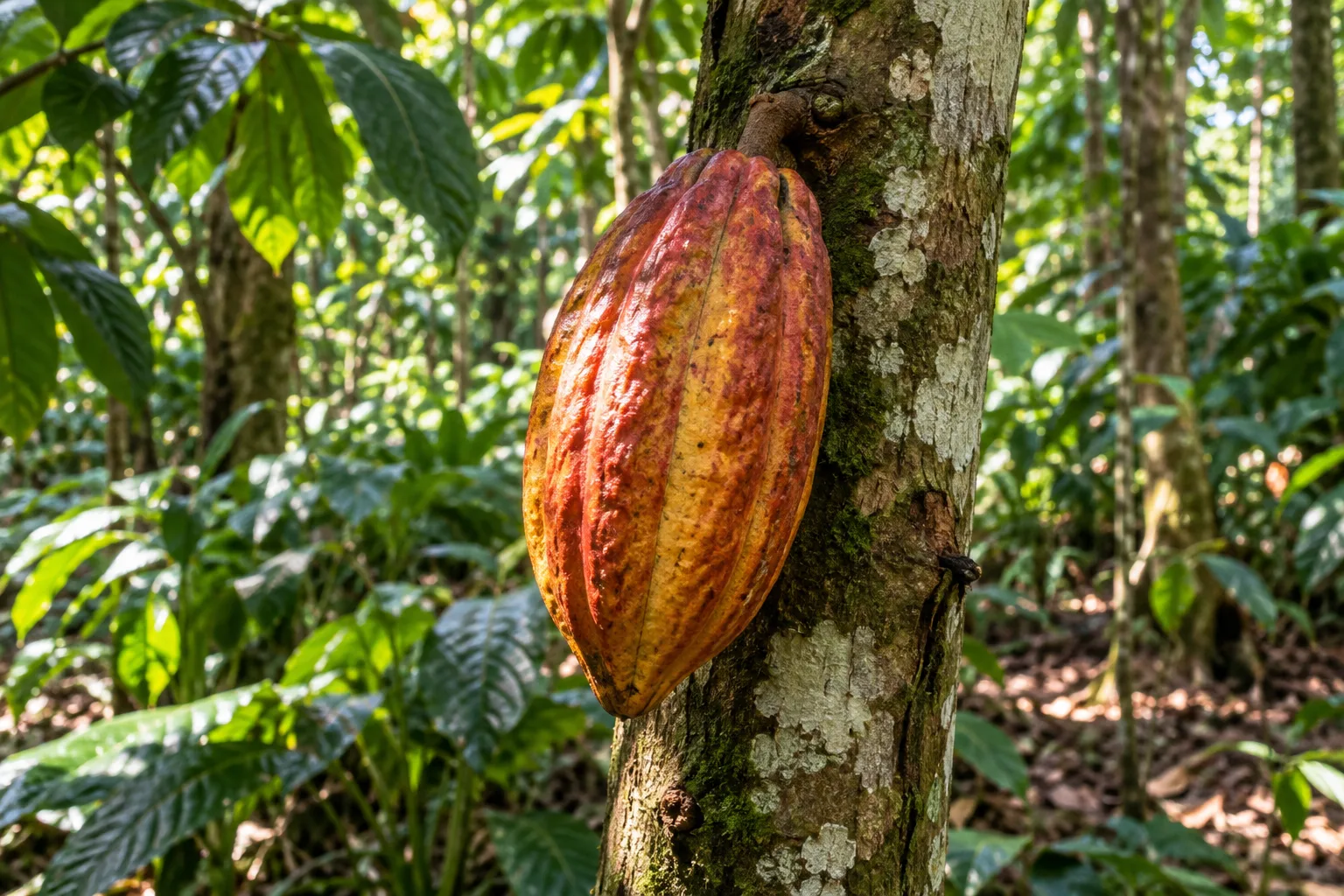
Place a wrapped chocolate bar beside a cacao pod and the relationship is not visually obvious. One is smooth, divided, and ready to eat; the other is a substantial fruit growing on a tropical tree. The distance between those appearances is a useful reminder that a familiar food can conceal both a biological origin and a great deal of human work.
Kew identifies Theobroma cacao as a tree associated with the wet tropics. Its flowers can emerge from the trunk and older branches, rather than only from the ends of small shoots. Inside the resulting fruit are seeds surrounded by pulp. Those seeds are the material commonly called cocoa beans, a food name that can obscure which part of the plant is being used.
Before a pod develops, pollination must occur. Smithsonian teaching resources use cacao as an example of a crop pollinated by flies. That detail broadens the familiar picture of pollination as something bees do to conspicuous garden flowers. Different flowers fit different visitors, and an inconspicuous insect can be part of the history of a conspicuous food.
At this point there is no finished chocolate hidden inside the tree. There is a fruit containing the raw material for further work. Keeping the parts distinct—flower, pod, pulp, seed—makes the rest of the journey easier to follow. It also avoids the misleading idea that manufacturing merely shapes a substance that already resembles a chocolate bar.
Work that happens after the harvest
The International Cocoa Organization describes harvesting as the removal of ripe pods followed by extraction of the wet beans. That is the start of processing, not its conclusion. The fruit has protected its contents on the tree; opening it creates a new set of handling tasks that are essential to the material’s later quality.
Fermentation acts on the pulp-covered beans through microbial activity and associated chemical changes. Drying then reduces moisture before storage and delivery. These are distinct operations. Calling either one simply “letting the beans sit” hides the fact that conditions and timing matter, and that the grower’s work continues after the pod leaves the branch.
The organization emphasizes that flavor development involves both fermentation and later roasting. This makes a useful correction to the factory-centered picture of chocolate: the processor does not receive a neutral material whose history can be ignored. Earlier handling influences what later processing can achieve. The final flavor has a chain of contributors rather than one moment of creation.
For a reader comparing foods, the lesson is to ask what a process does before judging it by its name. Fermentation is not a synonym for drying, and drying is not the same as roasting. Each changes the material in a different way. Understanding that sequence gives the less visible stages their proper place without reducing an intricate craft to a universal recipe or an exact timetable.
Several ingredients from one beginning
Further processing separates and transforms the material again. Winnowing removes shells from the inner pieces known as nibs. Grinding those nibs produces cocoa mass, while pressing can separate cocoa butter from the remaining cocoa material. The International Cocoa Organization’s processing overview distinguishes these stages rather than treating every intermediate product as one interchangeable brown ingredient.
Cocoa butter is the cocoa-derived fat. The word butter can invite a dairy association, but the name does not mean it comes from milk. A recipe may separately include milk ingredients, sugar, and other components. Recognizing the difference between an ingredient’s source and a recipe’s additions is more useful than relying on a familiar word alone.
The United States Botanic Garden presents cacao as a plant whose seeds lead to cocoa powder, butter, and chocolate. That small list captures the branching nature of the journey. There is no requirement that everything extracted from a pod end up in one identical product. Processing and formulation determine which properties are developed and how the resulting ingredients are combined.
The reward for tracing the route backward is a more precise view of an everyday treat. A bar connects plant reproduction, harvest decisions, microbial changes, drying, separation, and recipe choices. None of those facts tells you automatically which brand to prefer, and this is not a health claim. They explain why the finished object looks so unlike its beginning—and why the people working before the wrapper appears are part of its flavor story.
All 3 chapters
Sources & further reading
Checked . Explanation and commentary are original; factual claims draw on these primary sources.